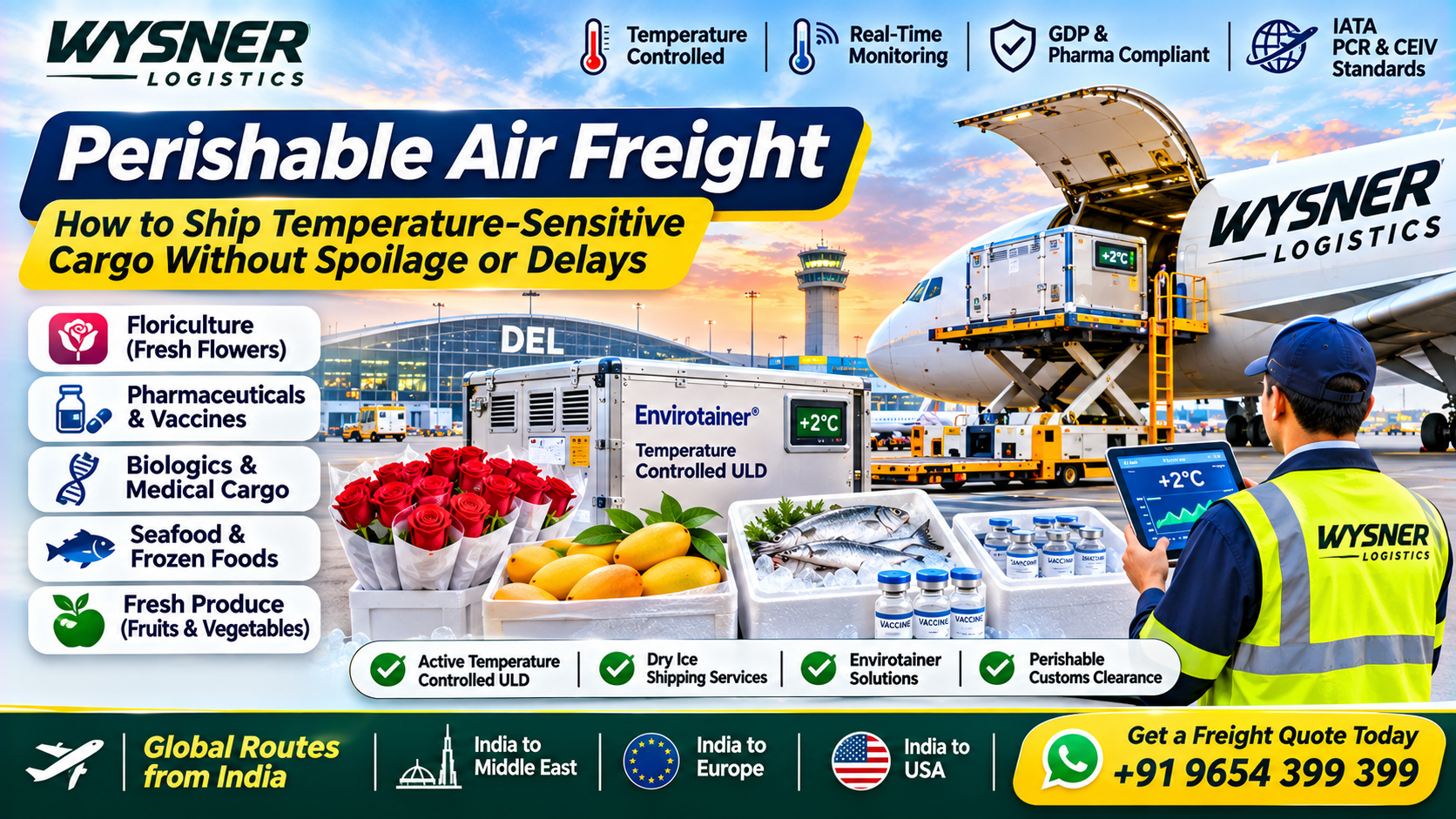
Perishable Air Freight: How to Ship Temperature-Sensitive Cargo Without Spoilage or Delays
Temperature-sensitive cargo requires more than an ordinary air freight booking. Fresh flowers, fruits, vegetables, seafood, frozen food, pharmaceutical products, vaccines and biological materials can lose their quality, safety or commercial value if exposed to unsuitable temperatures during transportation.
For exporters and importers, even a short interruption in the cold chain can result in product deterioration, rejected shipments, financial losses and regulatory complications.
This is why perishable air freight requires specialized packaging, temperature-controlled storage, appropriate airline selection, careful cargo handling, accurate documentation and coordinated customs clearance.
Whether you are exporting fresh produce from India to Europe, shipping flowers to the Middle East, transporting pharmaceutical products to the USA or arranging frozen vaccine air cargo transport, every stage of the shipping journey must be planned around the product’s specific temperature requirements.
WYSNER LOGISTICS provides international freight forwarding and logistics coordination for businesses requiring air freight and specialized cargo transportation arrangements, subject to cargo eligibility, route availability and operational requirements.
This comprehensive guide explains how to ship temperature-sensitive cargo by air without unnecessary spoilage or delays, how pharmaceutical cold-chain logistics work, what equipment is required, how to select a suitable freight forwarding partner and what exporters should know before booking.
How Do You Ship Perishable Cargo by Air Without Spoilage?
To ship perishable cargo safely by air, follow these essential steps:
- Identify the exact temperature and handling requirements of the product.
- Prepare suitable insulated or temperature-controlled packaging.
- Pre-condition or pre-cool the cargo where required.
- Select an airline and freight forwarding partner with suitable perishable cargo handling capabilities.
- Arrange temperature-controlled transportation to the airport.
- Use appropriate cold storage and minimize exposure to ambient temperatures.
- Prepare accurate shipping documents, labels and handling instructions.
- Plan customs clearance and destination delivery before dispatch.
- Use temperature data loggers or monitoring systems where required.
- Maintain contingency arrangements for flight delays, missed connections and customs holds.
The most important principle is to maintain the required temperature throughout the entire supply chain, not just during the flight.
1. What Is Perishable Air Freight?
Perishable air freight refers to the transportation of goods that can deteriorate, spoil, lose quality or become unusable when exposed to unsuitable environmental conditions or excessive transportation delays.
These products may require chilled, frozen, controlled-room-temperature or other specialized handling conditions.
Air freight is frequently selected for perishable products because it can reduce transportation time compared with many alternative shipping methods.
However, fast transportation alone does not guarantee product quality. The packaging, warehouse conditions, airport handling, aircraft loading, transit arrangements and final delivery must all be properly coordinated.
Common Types of Perishable Air Cargo
| Cargo Category | Examples | Main Logistics Consideration |
|---|---|---|
| Fresh produce | Mangoes, grapes, berries, vegetables | Temperature, humidity and shelf life |
| Floriculture | Roses, orchids, cut flowers | Hydration, temperature and handling |
| Seafood | Fish, prawns, shellfish | Chilled or frozen conditions |
| Meat and poultry | Fresh and frozen meat | Strict temperature control and hygiene |
| Dairy products | Cheese, butter and dairy preparations | Product-specific temperature requirements |
| Frozen food | Frozen vegetables, seafood and prepared food | Maintaining frozen conditions |
| Pharmaceuticals | Medicines and injectable products | Validated temperature management |
| Vaccines | Approved vaccine products | Manufacturer-defined temperature conditions |
| Biologics | Biological medicines and related products | Product-specific cold-chain controls |
| Laboratory materials | Certain samples and biological materials | Special packaging and regulatory compliance |
Each commodity has different transportation requirements. A flower shipment cannot automatically be handled in the same way as frozen seafood or pharmaceutical biologics.
The shipper must communicate the correct product-specific handling instructions before the cargo is booked.
2. Why Is Temperature Control So Important in Air Freight?
Temperature changes can affect the physical, chemical and biological properties of sensitive products.
For example:
- Fresh fruits may ripen too quickly.
- Vegetables may lose freshness and moisture.
- Cut flowers may wilt or develop reduced vase life.
- Seafood may deteriorate if chilled or frozen conditions are interrupted.
- Frozen products may partially thaw.
- Pharmaceutical products may experience temperature excursions that compromise product quality.
- Vaccines and biologics may become unsuitable for use if exposed outside their approved temperature limits.
The required temperature depends on the product, manufacturer specifications, packaging system and applicable regulations.
There is no single temperature suitable for every perishable shipment.
Temperature Control Must Continue Beyond the Aircraft
A typical international air freight shipment may pass through several stages:
- Supplier or production facility.
- Pre-cooling or temperature-conditioning facility.
- Refrigerated road transportation.
- Export warehouse.
- Airport cargo terminal.
- Security screening and acceptance.
- Aircraft loading.
- Transit airport, if applicable.
- Destination airport cargo terminal.
- Customs clearance.
- Final temperature-controlled delivery.
A failure at any of these stages can affect the shipment.
This is why professional perishable cargo logistics must consider the complete cold chain.
3. Understanding Different Temperature Requirements for Perishable Cargo
Different commodities require different environmental conditions.
The following table is an illustrative logistics guide, not a universal temperature specification. Always follow the product manufacturer’s instructions, validated packaging requirements and applicable transport regulations.
| Cargo Type | Typical Handling Category | Important Consideration |
|---|---|---|
| Fresh flowers | Chilled | Species-specific temperature and humidity |
| Fresh fruits | Chilled or controlled | Variety, maturity and ripening behaviour |
| Vegetables | Chilled or controlled | Product-specific storage requirements |
| Fresh seafood | Chilled | Hygiene and uninterrupted cooling |
| Frozen seafood | Frozen | Maintain the required frozen condition |
| Frozen meat | Frozen | Temperature stability and packaging |
| Certain pharmaceuticals | Controlled temperature | Product-approved temperature range |
| Vaccines | Manufacturer-defined | Product-specific cold-chain requirements |
| Biologics | Validated temperature-controlled | Stability and excursion management |
| Laboratory materials | Product-specific | Biological safety and handling requirements |
For example, certain pharmaceutical products may require controlled room temperature, while other products may require refrigerated or deep-frozen transportation.
Similarly, fresh flowers, tropical fruits and seafood cannot be assigned one common storage temperature.
Before booking perishable air freight, obtain the exact temperature range in writing from the manufacturer or product owner.
4. How to Choose a Perishable Air Freight Forwarder
Choosing the right logistics partner is one of the most important decisions when shipping temperature-sensitive cargo.
An ordinary freight forwarding arrangement may not be sufficient for cargo that requires special storage, controlled handling or temperature monitoring.
Look for a logistics provider that understands:
- Perishable cargo acceptance requirements
- Product-specific temperature instructions
- Special packaging requirements
- Temperature-controlled warehouse availability
- Airline and route capabilities
- Airport handling procedures
- Transit-time planning
- Customs documentation
- Regulatory requirements
- Shipment monitoring and exception management
IATA Perishable Cargo Regulations (PCR)
The International Air Transport Association (IATA) publishes the Perishable Cargo Regulations (PCR), which provide industry guidance and requirements for the air transportation of perishable goods.
The regulations cover areas including:
- Shipper and carrier responsibilities
- Packaging requirements
- Cargo handling procedures
- Booking and acceptance
- Documentation and labelling
- Ground operations
- Traceability
- Delivery procedures
- Commodity-specific considerations
Businesses should work with logistics providers and carriers that understand the applicable IATA PCR requirements and the relevant airline’s operating procedures.
A useful distinction for importers and exporters: searching for an IATA PCR certified air freight forwarder is common, but PCR compliance and formal certification are not the same thing. Ask what specific training, certification, procedures and operational capabilities the company actually holds.
IATA CEIV Fresh and Perishable Cargo Handling
IATA’s CEIV certification programmes are designed to improve the handling and transportation of specialised cargo.
For fresh and perishable products, CEIV Fresh is a relevant programme to investigate when evaluating supply-chain partners.
A shipper should verify the certification status of the actual organization, facility or service provider rather than assuming that every airline, forwarder or airport terminal involved is certified.
5. Perishable Floriculture Air Cargo Handler – Shipping Fresh Flowers Internationally
Floriculture is one of the most sensitive segments of perishable air cargo.
Fresh flowers are highly time-sensitive products. Their quality can deteriorate due to unsuitable temperatures, dehydration, poor ventilation, excessive handling and transportation delays.
India exports flowers such as:
- Roses
- Carnations
- Orchids
- Chrysanthemums
- Gerberas
- Lilies
- Other ornamental flowers and foliage
A professional perishable floriculture air cargo handler should understand the handling requirements of different flower varieties and coordinate the transportation process accordingly.
Important Requirements for Fresh Flower Air Freight
1. Harvesting and Pre-Cooling
Flowers should be harvested, processed and conditioned according to their species-specific post-harvest requirements.
2. Suitable Packaging
Packaging should protect the flowers from physical damage, dehydration and unsuitable environmental conditions.
3. Temperature Management
Different flower varieties have different temperature requirements. The correct conditions must be established before booking.
4. Ventilation and Moisture Control
Packaging should be appropriate for the flower variety and transport conditions.
5. Fast Airport Handling
Unnecessary waiting time at the cargo terminal and on the airport ramp should be minimised.
6. Destination Delivery
Flowers should move quickly from the arrival terminal to the consignee’s appropriate storage or distribution facility.
Why Is Air Freight Preferred for Fresh Flowers?
Air freight can reduce transportation time and provide access to international markets where freshness and delivery schedules are commercially important.
However, successful flower transportation depends on pre-shipment preparation, suitable airline handling and efficient destination operations.
6. Pharmaceutical Air Freight – Why GDP Compliance Matters
Pharmaceutical products require a higher level of supply-chain control than ordinary commercial cargo.
Many medicines are sensitive to temperature variations, humidity, light exposure and handling conditions.
A temperature excursion may compromise product quality even when the external packaging appears undamaged.
This is why pharmaceutical air freight must be planned around Good Distribution Practice (GDP) principles, manufacturer requirements and applicable national regulations.
What Is GDP Compliant Pharmaceutical Air Freight?
GDP compliant pharmaceutical air freight refers to air transportation arrangements designed to protect medicinal products through controlled handling, appropriate documentation, temperature management and quality procedures consistent with applicable Good Distribution Practice requirements.
Important considerations include:
- Defined temperature ranges
- Qualified packaging systems
- Temperature monitoring
- Documented handling procedures
- Trained personnel
- Route risk assessment
- Appropriate warehouse infrastructure
- Equipment maintenance and calibration
- Deviation reporting
- Corrective and preventive actions
- Documented responsibilities among supply-chain partners
GDP compliance should be assessed across the complete distribution arrangement.
A freight forwarder should not claim that an entire shipment is GDP compliant merely because a temperature-controlled container is used.
IATA Temperature Control Regulations (TCR)
IATA publishes Temperature Control Regulations (TCR) for pharmaceutical and healthcare cargo.
These regulations address temperature management, handling procedures, documentation and operational requirements for time- and temperature-sensitive healthcare shipments.
IATA also specifies the use of a Time and Temperature Sensitive label for shipments booked under the applicable healthcare cargo requirements.
IATA CEIV Pharma Air Cargo Carrier
When selecting an IATA CEIV Pharma air cargo carrier, pharmaceutical shippers should verify the actual certification status of the relevant organization through IATA’s official registry.
CEIV Pharma evaluates important areas such as:
- Quality management
- Personnel training
- Documentation
- Infrastructure and equipment
- Temperature monitoring
- Transportation planning
- Supplier management
- Operational procedures
- Audits and continuous improvement
CEIV Pharma certification is a useful indicator of specialised pharmaceutical logistics capabilities, but it does not replace product-specific regulatory requirements or a shipper’s own quality assessment.
7. Cold Chain Biologics Air Shipping – Protecting Sensitive Biological Products
Biologics are medicines derived from biological sources and may include vaccines, blood-related products, therapeutic proteins, monoclonal antibodies and other specialised treatments.
Many biologics are sensitive to temperature fluctuations and may require validated packaging and controlled transportation.
Cold chain biologics air shipping involves coordinating the movement of these products under defined environmental conditions from the manufacturing facility to the final authorized recipient.
Key Requirements for Biologics Air Freight
- Manufacturer-approved temperature range
- Qualified thermal packaging
- Validated transportation procedures
- Appropriate temperature monitoring
- Trained handling personnel
- Controlled warehouse storage
- Documented route risk assessment
- Shipment contingency planning
- Secure and timely delivery
- Temperature excursion management
Why Is Route Qualification Important?
A direct flight may reduce transit time, but it does not automatically guarantee a safer shipment.
A route should be evaluated according to:
- Origin airport capabilities
- Transit airport facilities
- Destination airport infrastructure
- Ground handling arrangements
- Available temperature-controlled storage
- Connection times
- Flight frequency
- Seasonal weather conditions
- Customs procedures
For high-value biologics, the shipper should evaluate the entire route and approve the transportation arrangement before dispatch.
8. Temperature Monitored Medical Air Courier Services
A temperature monitored medical air courier arrangement is designed for medical and pharmaceutical products that require temperature visibility during transportation.
Depending on the service, monitoring may involve:
- Electronic temperature data loggers
- Real-time tracking devices
- GPS-enabled shipment monitoring
- Humidity sensors
- Shock and vibration monitoring
- Electronic alerts
- Temperature excursion reports
Real-Time Temperature Monitored Air Cargo
Real-time temperature monitored air cargo gives authorised stakeholders access to shipment condition information while the cargo is in transit, where the selected device and service support live connectivity.
This can help logistics teams identify potential problems and respond more quickly.
For example, a monitoring system may indicate:
- Temperature moving outside the defined range
- Unexpected delay at a transit airport
- Excessive exposure to ambient conditions
- A prolonged warehouse hold
- A route disruption
However, real-time visibility is not the same as active temperature control.
A monitoring device records or transmits information. It does not necessarily cool or heat the cargo.
A complete monitoring arrangement should also specify who receives alerts, who is responsible for responding and how deviations are documented.
9. Frozen Vaccine Air Cargo Transport – Special Handling Requirements
Vaccines may have highly specific temperature and handling requirements.
Some vaccines are maintained under refrigerated conditions, while certain products require frozen or ultra-low-temperature arrangements.
The required conditions must always follow the manufacturer’s approved product specifications and applicable health authority guidance.
Frozen vaccine air cargo transport requires careful coordination of:
- Manufacturer-approved temperature requirements
- Validated insulated packaging
- Appropriate refrigerants or active temperature-controlled equipment
- Temperature monitoring
- Airline acceptance
- Cargo terminal storage
- Security screening arrangements
- Customs documentation
- Destination receiving procedures
- Contingency planning
Why Is Vaccine Transportation Different from General Frozen Cargo?
Vaccines are pharmaceutical products with specific stability, quality and regulatory requirements.
A frozen food shipment and a vaccine shipment cannot be treated as equivalent simply because both require low temperatures.
The packaging, temperature limits, handling procedures, monitoring requirements and release decisions must be based on the vaccine manufacturer’s specifications.
If a temperature excursion occurs, the shipment should be managed according to the manufacturer’s and responsible quality authority’s documented procedures. The product should not automatically be assumed suitable for use.
10. Active Temperature Controlled ULD Air Freight
A Unit Load Device (ULD) is a specialized container or pallet system used to load cargo onto aircraft.
Some temperature-sensitive shipments use active temperature-controlled ULDs.
Active temperature controlled ULD air freight uses equipment with an integrated temperature management system designed to maintain the required environment during transportation within the equipment’s qualified operating limits.
How Does an Active Temperature-Controlled ULD Work?
An active temperature-controlled container may include:
- Insulated container walls
- Heating and cooling systems
- Temperature sensors
- Battery or power systems
- Temperature control electronics
- Monitoring and alarm functions
- Equipment identification and tracking
The selected ULD must be suitable for the shipment’s temperature requirements, size, route, aircraft compatibility and handling conditions.
Benefits of Active Temperature-Controlled Containers
- More controlled internal cargo conditions
- Reduced dependence on external refrigerants
- Suitable for certain long-distance pharmaceutical shipments
- Potential protection during airport transfers
- Integrated monitoring capabilities, depending on equipment
Active containers are specialised equipment and require advance planning, availability confirmation and compatible airline handling arrangements.
11. Envirotainer Air Freight Forwarder – Understanding Pharmaceutical Container Solutions
Envirotainer is a specialised provider of temperature-controlled air cargo solutions for pharmaceutical and life-science shipments.
An Envirotainer air freight forwarder is a freight forwarding partner that can coordinate bookings and transportation arrangements using suitable Envirotainer equipment when available and appropriate.
Envirotainer solutions are designed for the transportation of temperature-sensitive pharmaceutical products.
What Should Shippers Check Before Booking an Envirotainer Shipment?
- Is the required container model available?
- Is the equipment suitable for the product’s temperature range?
- Is it compatible with the selected airline and route?
- Are origin and destination handling arrangements confirmed?
- Is the container available at the required location?
- Are collection and return arrangements defined?
- Are monitoring and shipment documentation requirements covered?
- Is contingency support available?
Active vs Passive Temperature-Controlled Packaging
| Feature | Active System | Passive System |
|---|---|---|
| Temperature management | Powered temperature control | Insulation and thermal materials |
| Cooling or heating | Equipment-based | Uses qualified thermal components |
| Power requirement | Usually requires an energy source | Generally does not require continuous external power |
| Monitoring | May include integrated monitoring | May use separate data loggers |
| Application | Suitable for certain complex or long-distance shipments | Suitable for validated shipment profiles |
| Cost | Generally higher | Depends on packaging and refrigerant requirements |
The correct system depends on the shipment, temperature range, route, duration, cargo value and risk assessment.
12. Dry Ice Air Cargo Shipping Services – Requirements and Safety
Dry ice is solid carbon dioxide and is commonly used as a refrigerant for frozen and temperature-sensitive cargo.
It is particularly relevant for certain pharmaceutical products, biological materials and frozen shipments.
Dry ice air cargo shipping services require special attention because dry ice releases carbon dioxide gas as it sublimates.
This creates pressure and ventilation considerations during transportation.
Dry ice shipments are subject to applicable dangerous goods requirements, including relevant IATA Dangerous Goods Regulations and airline restrictions.
Important Dry Ice Shipping Considerations
1. Correct Packaging
Packaging must be suitable for the product and dry ice, with appropriate arrangements for gas release where required.
2. Accurate Quantity Declaration
The amount of dry ice must be correctly calculated and declared according to the applicable rules.
3. Proper Labelling
Packages must carry the applicable markings and labels required for the shipment.
4. Documentation
The shipper must prepare the necessary transport documentation and declarations.
5. Airline Approval
Not every airline or aircraft arrangement accepts every dry ice shipment. Acceptance depends on the applicable limits, route and operator requirements.
6. Transit Planning
The quantity of refrigerant must be planned around the anticipated journey and product-specific thermal performance.
7. Destination Handling
The receiving party should be prepared to accept and handle the shipment appropriately.
Never assume that ordinary packaging is suitable for dry ice cargo. Engage a competent dangerous goods professional when required.
13. Perishable Customs Clearance Broker – Avoiding Delays at Indian Airports
Customs clearance is one of the most important stages in international perishable cargo transportation.
Even when a shipment arrives on time, delays in documentation, examination, permits or regulatory approvals can affect the product’s remaining shelf life.
A perishable customs clearance broker should understand the customs and product-specific requirements associated with temperature-sensitive goods.
Important Customs Clearance Considerations
- Correct HS classification
- Accurate commercial invoice
- Packing list
- Air Waybill
- Country of origin details
- Import or export licences, where applicable
- Product-specific health certificates
- Phytosanitary certificates for relevant plant products
- Food safety documentation where required
- Pharmaceutical approvals where applicable
- Other documents required by the competent authority
Customs Clearance for Fresh Produce
Fresh fruits, vegetables and plant products may be subject to phytosanitary and other import or export controls.
The exact requirements depend on the product, origin, destination and applicable plant quarantine regulations.
Customs Clearance for Pharmaceutical Products
Medicines and biological products may require additional documentation, licences, registrations and approvals from the relevant authorities.
The shipper should confirm these requirements before cargo dispatch.
How to Reduce Perishable Cargo Customs Delays
- Confirm import or export eligibility before booking.
- Prepare all required documents in advance.
- Check product descriptions and HS classification.
- Confirm any necessary licences and certificates.
- Share shipment details with the customs broker before arrival.
- Coordinate with the airline and cargo terminal.
- Arrange immediate post-clearance transportation.
- Maintain a contingency plan for examination or regulatory queries.
A freight forwarder can coordinate the logistics process, but regulated customs representation must be carried out by the appropriate authorised Customs Broker.
14. Perishables Air Freight Handler DEL – Shipping Temperature-Sensitive Cargo Through Delhi
Delhi is an important international air cargo gateway for North India.
Businesses exporting flowers, fresh produce, seafood, pharmaceuticals and other temperature-sensitive products may use Indira Gandhi International Airport (DEL), depending on the route and available cargo facilities.
A perishables air freight handler DEL arrangement should be evaluated according to the airport’s available handling infrastructure, the airline’s capabilities and the cargo’s specific temperature requirements.
Cold Storage Air Cargo Terminal Delhi
A cold storage air cargo terminal Delhi search usually reflects the need for airport facilities capable of handling chilled, frozen or temperature-sensitive cargo.
Before booking, confirm the following with the relevant airline, terminal operator or handling agent:
- Availability of the required temperature-controlled storage
- Accepted temperature ranges
- Cargo acceptance cut-off times
- Pre-alert and booking procedures
- Handling of frozen and chilled products
- Storage arrangements during transit
- Special handling requirements
- Cargo release and delivery arrangements
Not every cargo terminal or airline offers the same temperature-controlled facilities.
IATA Perishable Freight Forwarder in Delhi
Businesses searching for an IATA perishable freight forwarder in Delhi should assess the freight forwarder’s experience with perishable cargo, understanding of applicable IATA PCR procedures, airline relationships, packaging coordination and airport handling arrangements.
Also verify whether the relevant carrier, terminal or handling partner holds any specific certification that your shipment requires.
WYSNER LOGISTICS can discuss international air freight coordination for eligible shipments from Delhi, subject to cargo acceptance, airline availability and the operational capabilities of the selected handling partners.
15. Perishables Air Freight Handler BOM – Mumbai International Cargo
Mumbai is another important international cargo gateway for Indian exporters and importers.
Businesses exporting fresh produce, flowers, seafood, pharmaceutical products and other temperature-sensitive goods may consider Chhatrapati Shivaji Maharaj International Airport (BOM), depending on the route and cargo requirements.
A perishables air freight handler BOM should be selected according to:
- Product category
- Required temperature range
- Airport storage capabilities
- Airline acceptance
- Cargo handling procedures
- Export documentation
- Transit time
- Destination airport infrastructure
- Final delivery arrangements
Mumbai’s role as an international trade gateway makes it relevant for businesses handling temperature-sensitive shipments from western and central India.
However, the actual cargo route and handling capability should always be confirmed before shipment booking.
16. Perishable Air Freight from India to Middle East
The Middle East is an important destination for Indian exporters of fresh produce, flowers, seafood, food products and other eligible temperature-sensitive goods.
Perishable air freight from India to Middle East may involve shipments to destinations such as:
- Dubai
- Abu Dhabi
- Sharjah
- Doha
- Riyadh
- Jeddah
- Muscat
- Kuwait City
- Manama
Key Considerations for Middle East Perishable Shipments
High ambient temperatures can create additional challenges during airport handling and ground transportation.
Exporters should pay attention to:
- Pre-cooling before dispatch
- Insulated or suitable thermal packaging
- Short airport dwell time
- Appropriate aircraft routing
- Temperature-controlled destination storage
- Customs and food import documentation
- Final refrigerated delivery
The destination country’s food safety and import requirements must be checked before dispatch.
17. Fresh Produce Air Cargo India to Europe
Europe is an important destination market for Indian fresh produce exports.
Fresh produce air cargo India to Europe may include:
- Mangoes
- Grapes
- Pomegranates
- Fresh vegetables
- Specialty fruits
- Selected herbs
- Other eligible agricultural products
The exact products accepted depend on the destination country’s import regulations, phytosanitary requirements and commercial market conditions.
Important Requirements for Exporting Fresh Produce to Europe
Phytosanitary Compliance
Relevant plant health documentation and inspection requirements must be met.
Product Quality
Products should meet the buyer’s quality, maturity, grading and packaging specifications.
Temperature Management
The product should be transported under its recommended temperature and handling conditions.
Traceability
Exporters should maintain the required origin, supplier and product traceability records.
Customs and Import Documentation
Check the relevant destination requirements, including food safety and plant health controls.
Why Is Air Freight Used for Fresh Produce Exports?
Air freight may be suitable for high-value or short-shelf-life produce where fast transportation supports the commercial objective.
For products with longer shelf life and suitable handling requirements, other transportation methods may also be considered.
The right mode depends on the product, delivery deadline, market value and total logistics cost.
18. Cold Chain Air Shipping India to USA
The United States is a significant market for pharmaceutical, healthcare and selected food-related shipments from India.
Cold chain air shipping India to USA requires careful coordination between the Indian exporter, airline, freight forwarder, destination handler, customs broker and receiving party.
Potential shipment categories include:
- Pharmaceutical products
- Temperature-sensitive healthcare products
- Approved biological materials
- Fresh produce
- Selected food products
- Other eligible temperature-sensitive cargo
Important Requirements for India-to-USA Cold Chain Shipping
- Product-specific temperature specifications
- Qualified thermal packaging
- Appropriate monitoring equipment
- Airline route and transit assessment
- US import eligibility
- FDA or other regulatory requirements, where applicable
- Customs documentation
- Destination cold storage
- Final temperature-controlled transportation
For pharmaceuticals, shippers should also consider the applicable US regulatory requirements and the receiving organisation’s quality procedures.
For food and agricultural products, the relevant US food safety, agricultural and import requirements must be checked before dispatch.
19. Common Causes of Perishable Air Freight Spoilage and Delays
Even a well-planned air shipment can face unexpected challenges.
The following problems are among the common reasons for perishable cargo losses.
1. Incorrect Temperature Selection
Using the wrong temperature setting can damage the product.
Solution: Obtain the manufacturer’s or product specialist’s written handling instructions.
2. Poor Packaging
Ordinary cartons may not provide sufficient thermal protection.
Solution: Use packaging qualified for the product, route and expected transportation duration.
3. Insufficient Pre-Cooling
Cargo loaded before reaching the required condition may experience temperature instability.
Solution: Complete the appropriate pre-conditioning process before dispatch.
4. Airline Schedule Changes
Flight delays, cancellations and missed connections can increase transit time.
Solution: Evaluate direct or lower-risk routing options and prepare alternative arrangements.
5. Long Airport Waiting Time
Cargo may be exposed to unsuitable ambient conditions during terminal or ramp handling.
Solution: Confirm handling arrangements, storage availability and cargo acceptance timing.
6. Customs Documentation Errors
Incorrect invoices, missing certificates or incomplete declarations can delay release.
Solution: Share documents with the relevant customs professional before shipment dispatch.
7. Inadequate Temperature Monitoring
Without appropriate monitoring, a temperature deviation may remain undetected.
Solution: Use suitable data loggers or real-time monitoring systems based on the cargo’s risk and requirements.
8. Unplanned Destination Delivery
Cargo may remain at the destination terminal if the consignee is not prepared to receive it.
Solution: Confirm customs, storage and final delivery arrangements before departure.
20. Step-by-Step Process for Booking Perishable Air Freight
A structured booking process reduces operational confusion.
| Stage | Activity | Responsible Party |
|---|---|---|
| 1 | Confirm product and temperature requirements | Shipper / Manufacturer |
| 2 | Check import and export eligibility | Shipper / Importer |
| 3 | Select packaging and refrigerant | Shipper / Packaging specialist |
| 4 | Evaluate route and airline | Freight forwarder / Carrier |
| 5 | Confirm temperature-controlled facilities | Airline / Handler |
| 6 | Prepare documents and labels | Shipper / Forwarder |
| 7 | Arrange temperature-controlled pickup | Transport provider |
| 8 | Deliver and present cargo for acceptance | Shipper / Forwarder |
| 9 | Complete security and cargo handling | Airport handler / Airline |
| 10 | Monitor shipment and transit | Agreed supply-chain partners |
| 11 | Coordinate customs clearance | Importer / Customs Broker |
| 12 | Complete temperature-controlled delivery | Destination logistics provider |
Every party should understand its responsibilities before cargo dispatch.
21. Air Freight vs Sea Freight for Perishable Cargo
Air freight is not always the best choice for every perishable product.
The right shipping method depends on the product’s shelf life, value, quantity, destination and required delivery time.
| Factor | Air Freight | Sea Freight |
|---|---|---|
| Transit time | Generally faster | Generally longer |
| Transportation cost | Usually higher | Often economical for larger volumes |
| Shipment size | Suitable for smaller and high-value shipments | Suitable for larger cargo volumes |
| Fresh flowers | Often suitable | Depends on variety and journey duration |
| Fresh produce | Suitable for selected short-shelf-life products | Suitable for products with appropriate shelf life |
| Frozen food | Possible with suitable equipment and handling | Possible with refrigerated containers |
| Pharmaceuticals | Suitable with qualified cold-chain arrangements | Product and route dependent |
| Monitoring | Available depending on equipment and service | Available depending on equipment and service |
When Should You Choose Air Freight?
Choose air freight when:
- The product has a short shelf life.
- The buyer requires faster delivery.
- The cargo has a high commercial value.
- The destination market demands rapid transportation.
- The product’s stability requirements can be maintained through the selected air route.
When Should You Consider Sea Freight?
Consider sea freight when:
- The cargo volume is large.
- The product has a suitable shelf life.
- Refrigerated container transportation is available.
- The shipping schedule meets the buyer’s requirements.
- The total landed cost is more competitive.
22. How to Select the Right Cold Chain Air Freight Partner
Before booking a temperature-sensitive shipment, ask the logistics provider these questions:
- Have you handled this product category before?
- Which airline or carrier will transport the shipment?
- What temperature-controlled storage is available at origin?
- Is the transit airport suitable for the required temperature range?
- What packaging system is recommended?
- Can the shipment use active or passive temperature-controlled equipment?
- Are temperature data loggers or real-time tracking available?
- Who receives alerts if a temperature excursion occurs?
- What happens if the flight is delayed?
- Who coordinates customs clearance?
- Is the destination handler prepared to receive the shipment?
- Can the logistics provider supply a written handling plan?
For pharmaceutical cargo, also ask about GDP procedures, CEIV Pharma certification status, quality agreements and documented route risk assessments.
For fresh produce and floriculture, ask about perishable cargo handling experience, PCR knowledge, airport cold storage and destination delivery.
23. How WYSNER LOGISTICS Supports International Air Freight Requirements
WYSNER LOGISTICS, operated by WYSNER GLOBAL INC, provides international freight forwarding and logistics coordination for businesses shipping commercial cargo between India and international markets.
We understand that sensitive cargo requires careful planning, clear communication and coordination among multiple logistics stakeholders.
Our freight forwarding services include:
- International air freight
- International sea freight – LCL and FCL
- Import and export logistics coordination
- Cargo consolidation
- Supplier pickup coordination
- International shipment planning
- Customs clearance coordination through appropriate authorised professionals
- Air DDP arrangements for eligible cargo, subject to legal and operational requirements
Perishable Air Freight Enquiries
For businesses planning temperature-sensitive air shipments, we can discuss the shipment requirements and evaluate possible freight arrangements based on:
- Commodity and product description
- Required temperature range
- Gross weight and dimensions
- Packaging type
- Origin and destination airports
- Required delivery date
- Airline and handling availability
- Applicable import and export regulations
Important Service Qualification
Temperature-controlled storage, CEIV-certified handling, pharmaceutical cold-chain equipment, active ULDs, Envirotainer equipment and real-time temperature monitoring are specialised services.
Their availability must be confirmed with the relevant airline, airport handler, equipment provider and destination logistics partner for each route.
WYSNER LOGISTICS does not claim to be an IATA CEIV Pharma-certified carrier, a CEIV Fresh-certified facility or an airport cold-storage operator unless such credentials are independently established.
Our role is to evaluate the logistics requirements and coordinate suitable international freight arrangements within the confirmed service scope.
24. Frequently Asked Questions About Perishable Air Freight
What is perishable air freight?
Perishable air freight is the transportation of products that can spoil, deteriorate or lose quality when exposed to unsuitable temperatures, humidity, handling conditions or delays.
Examples include fresh flowers, fruits, vegetables, seafood, frozen food, medicines and vaccines.
How do you prevent perishable cargo from spoiling during air transportation?
Use suitable packaging, maintain the product-specific temperature range, pre-condition cargo where required, select an appropriate airline and route, minimise airport dwell time and coordinate customs clearance and destination delivery.
What is IATA PCR in perishable cargo transportation?
IATA Perishable Cargo Regulations (PCR) provide industry regulations and guidance for the packaging, booking, documentation, handling and transportation of perishable air cargo.
What is GDP compliant pharmaceutical air freight?
It refers to pharmaceutical air transportation arrangements designed to maintain product quality through documented procedures, appropriate temperature controls, trained personnel and compliance with applicable Good Distribution Practice requirements.
What is CEIV Pharma certification?
CEIV Pharma is an IATA certification programme designed to assess pharmaceutical logistics capabilities, including quality management, personnel, documentation, infrastructure, temperature monitoring and transportation procedures.
What is an active temperature-controlled ULD?
An active temperature-controlled ULD is an aircraft-compatible cargo container with integrated temperature management equipment designed to maintain specified conditions within its qualified operating range.
What is an Envirotainer container?
Envirotainer provides specialised temperature-controlled air cargo solutions used in pharmaceutical and life-science logistics. Equipment selection depends on the product, route and operational availability.
Can dry ice be used for pharmaceutical air freight?
Yes, dry ice can be used for suitable products, but the shipment must comply with applicable dangerous goods requirements, airline acceptance rules, packaging and documentation procedures.
Can fresh flowers be shipped from India by air?
Yes. Eligible flower shipments can be transported internationally by air when the packaging, handling, phytosanitary documentation and destination requirements are satisfied.
Can fresh produce be exported from India to Europe by air?
Yes, eligible fresh produce can be exported by air subject to destination-specific plant health, food safety, customs and import requirements.
Can pharmaceutical products be shipped from India to the USA?
Yes, eligible pharmaceutical shipments can be transported by air subject to product approval, applicable US import requirements, packaging, temperature control and documentation.
What is the difference between temperature monitoring and temperature control?
Temperature monitoring records or communicates the cargo’s temperature. Temperature control uses packaging, refrigerants or powered equipment to maintain the required temperature conditions. Monitoring alone does not guarantee temperature stability.
Does every perishable shipment require refrigerated packaging?
No. Packaging depends on the commodity and its handling requirements. Some products require insulated packaging, others need refrigerants, and some may need active temperature-controlled equipment.
How can I get a perishable air freight quotation from India?
Provide the product description, temperature range, origin, destination, weight, dimensions, packaging type, expected cargo-ready date and any special handling requirements.
Does WYSNER LOGISTICS arrange international air freight?
WYSNER LOGISTICS coordinates international air freight and other freight forwarding requirements, subject to cargo eligibility, route availability and confirmed handling arrangements.
25. Get an International Air Freight Quotation from WYSNER LOGISTICS
Planning to export fresh flowers, fruits, vegetables, seafood, frozen products or temperature-sensitive pharmaceutical cargo?
Choosing the right shipping arrangement is essential to protect product quality and reduce the risk of spoilage, temperature excursions and unnecessary delays.
WYSNER LOGISTICS can discuss your international freight requirements and evaluate suitable transportation arrangements based on your cargo details, destination and delivery timeline.
Details Required for a Perishable Air Freight Quotation
Please share:
- Product or commodity name
- Required temperature range
- Origin city and airport
- Destination city and airport
- Gross weight
- Number of packages
- Carton dimensions
- Packaging type
- Dry ice or refrigerant requirements, if applicable
- Cargo-ready date
- Required delivery date
- Product-specific licences or certificates, if applicable
WYSNER LOGISTICS
International Freight Forwarding & Logistics Solutions
WhatsApp / Contact: +91 9654 399 399
Email: info@wysnerlogistics.com
Website: https://wysnerlogistics.com/
Contact us to discuss international air freight, sea freight, import-export logistics and specialised cargo transportation requirements.
Disclaimer: Temperature ranges, packaging requirements, airline acceptance, cargo handling procedures, customs requirements and transit arrangements depend on the specific product, manufacturer instructions, destination regulations, carrier rules and operational availability. Pharmaceutical and vaccine shipments must follow applicable health authority and manufacturer requirements. Dangerous goods such as dry ice must comply with current applicable transport regulations. This article is for general informational purposes and does not constitute pharmaceutical, medical, regulatory or customs advice.
Also Read: China to India Import Agent in Delhi | customs clearing agent in Delhi | Freight Forwarders in Delhi. | Freight Forwarding Company Near Me | volumetric weight calculation for air freight
