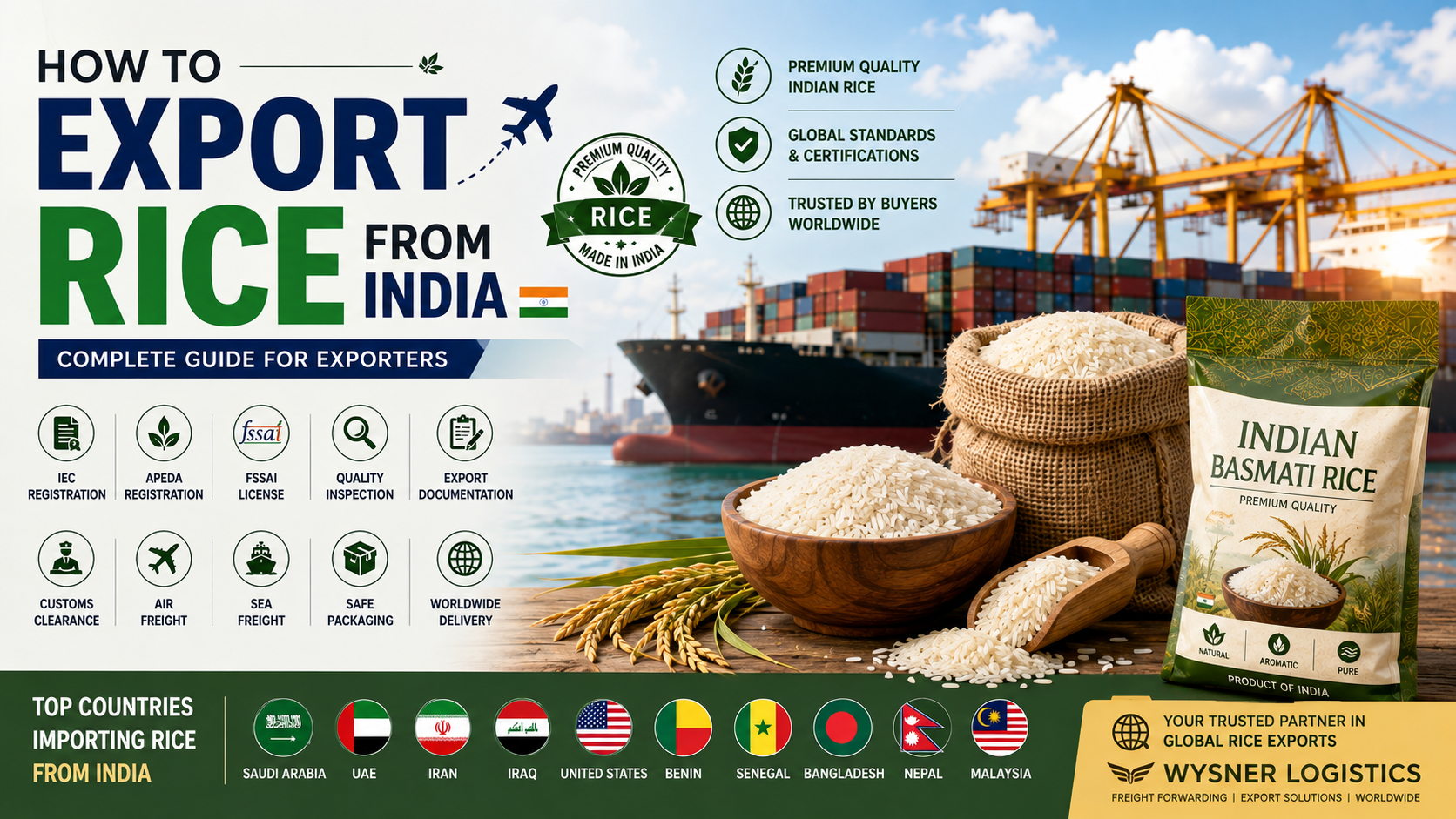
How to Export Rice from India
Complete Export Guide for Beginners & Businesses
India is the world’s largest exporter of rice and is recognized globally for producing premium-quality Basmati Rice, Non-Basmati Rice, Parboiled Rice, Steam Rice, Raw Rice and several specialty rice varieties. Indian rice is exported to more than 150 countries and is widely appreciated for its aroma, taste, nutritional value and competitive pricing.
Growing global demand for high-quality food products has created excellent opportunities for Indian exporters. Whether you are an entrepreneur, rice mill owner, food manufacturer, trader or agricultural exporter, rice export offers a profitable international business opportunity.
However, successful rice exports require more than simply finding overseas buyers. Exporters must comply with Indian export regulations, maintain international quality standards, prepare accurate documentation, arrange efficient logistics and ensure timely delivery to international customers.
This comprehensive guide explains everything you need to know about exporting rice from India, including registrations, certifications, documentation, packaging, shipping methods and the major international markets importing Indian rice.
Why Export Rice from India?
India has earned a strong reputation as one of the most trusted suppliers of rice in the global market. Favorable climatic conditions, fertile agricultural land, modern milling facilities and decades of export experience enable India to supply premium-quality rice at competitive prices.
Advantages of Exporting Indian Rice
- World’s leading rice exporter.
- Wide range of rice varieties.
- Excellent international demand.
- Competitive pricing.
- High-quality processing facilities.
- Strong agricultural production.
- Government export support.
- Established global buyer network.
- Long shelf life with proper packaging.
- Growing demand for premium and organic rice.
Major Types of Rice Exported from India
India exports a wide range of rice varieties to meet the preferences of consumers and food industries around the world. Each variety serves different markets depending on taste, aroma, grain length, cooking characteristics and end-use applications.
| Rice Variety | Characteristics | Popular Export Markets |
|---|---|---|
| Basmati Rice | Extra-long grain, aromatic and premium quality. | UAE, Saudi Arabia, Iran, Iraq, USA, UK |
| Non-Basmati Rice | Economical, versatile and widely consumed. | Africa, Asia, Middle East |
| Parboiled Rice | Nutrient-rich with longer shelf life. | Africa, Middle East |
| Steam Rice | Soft texture and excellent cooking quality. | Middle East, Europe |
| Raw Rice | Natural processed rice suitable for multiple applications. | Global Markets |
| Brown Rice | Whole grain with higher nutritional value. | USA, Canada, Europe |
| Organic Rice | Cultivated without synthetic chemicals. | USA, Germany, Australia, Japan |
| Broken Rice | Used for food processing, brewing and animal feed. | Africa, Southeast Asia |
Major Rice Producing States in India
Rice cultivation is spread across several Indian states, each contributing different varieties and qualities suitable for domestic consumption and export.
| State | Major Rice Varieties |
|---|---|
| Punjab | Basmati Rice |
| Haryana | Basmati Rice |
| Uttar Pradesh | Basmati & Non-Basmati Rice |
| Madhya Pradesh | Non-Basmati Rice |
| West Bengal | Parboiled & Non-Basmati Rice |
| Chhattisgarh | Raw Rice |
| Odisha | Parboiled Rice |
| Andhra Pradesh | Steam & Non-Basmati Rice |
| Telangana | Steam Rice |
| Tamil Nadu | Premium Rice Varieties |
Global Demand for Indian Rice
Indian rice is exported to supermarkets, wholesalers, food processors, hotels, restaurants and government procurement agencies across the globe. Growing populations, increasing food security requirements and the popularity of Indian cuisine continue to drive international demand.
Basmati rice remains one of India’s most valuable agricultural export products due to its premium positioning, while Non-Basmati and Parboiled rice are widely imported for staple food consumption in Asia, Africa and the Middle East.
Key Factors Driving Global Demand
- Premium quality grains.
- Distinct aroma and taste.
- Competitive export pricing.
- Reliable supply chain.
- Large production capacity.
- International food safety compliance.
- Growing demand for healthy food.
- Expanding Indian diaspora worldwide.
- Versatile culinary applications.
- Strong reputation in global markets.
Who Can Start a Rice Export Business?
Rice export is suitable for entrepreneurs and businesses of different sizes. With the right registrations, supplier network and logistics partner, even small businesses can successfully enter international markets.
- Rice Mill Owners
- Agricultural Exporters
- Food Processing Companies
- Merchant Exporters
- Farmer Producer Organizations (FPOs)
- Wholesalers & Distributors
- Private Label Food Brands
- Startups in Food Export
- International Trading Companies
- Organic Food Exporters
Why Choose India for Rice Sourcing?
India combines abundant agricultural production with modern processing infrastructure, making it one of the most reliable sources of rice for international buyers. Exporters can supply both bulk and retail-packed products while offering customization, private labeling and long-term supply agreements.
In the next section, we’ll cover the complete export process, including IEC registration, APEDA registration, FSSAI compliance, packaging standards, documentation, HS Code guidance, customs clearance and choosing between air freight and sea freight for rice exports.
Step-by-Step Process to Export Rice from India
Exporting rice from India involves obtaining the required registrations, sourcing quality rice, complying with food safety standards, preparing export documentation and arranging international logistics. Following a systematic process helps exporters build long-term relationships with overseas buyers while ensuring smooth customs clearance.
Step 1 – Register Your Business
Before starting your export business, register your company under an appropriate business structure.
- Sole Proprietorship
- Partnership Firm
- Limited Liability Partnership (LLP)
- Private Limited Company
- One Person Company (OPC)
Step 2 – Obtain Import Export Code (IEC)
The Import Export Code (IEC), issued by the Directorate General of Foreign Trade (DGFT), is mandatory for exporting commercial shipments from India.
Documents Required for IEC Registration
- PAN Card
- Aadhaar Card / Passport
- Business Registration Certificate
- Bank Account Details
- Cancelled Cheque
- Business Address Proof
- Email ID
- Mobile Number
Once issued, the IEC enables businesses to export goods from India, subject to applicable regulations.
Step 3 – APEDA Registration (RCMC)
Most agricultural exporters dealing with scheduled products should obtain APEDA Registration-cum-Membership Certificate (RCMC). APEDA supports exporters through export promotion, international exhibitions, quality improvement programs and market development initiatives.
Benefits of APEDA Registration
- Government Recognition
- Export Promotion Assistance
- International Trade Fair Participation
- Market Intelligence
- Training Programs
- Financial Assistance under Eligible Schemes
- Buyer-Seller Meets
- Global Brand Promotion
Step 4 – FSSAI Food License
Rice exporters involved in processing, packaging or manufacturing food products should obtain the appropriate FSSAI license based on their operations. Compliance with food safety standards improves buyer confidence and supports access to international markets.
Advantages of FSSAI Compliance
- Food Safety Assurance
- International Buyer Confidence
- Improved Product Traceability
- Regulatory Compliance
- Better Export Opportunities
Step 5 – Source Premium Quality Rice
Quality is the most important factor in international rice trade. Overseas buyers evaluate rice based on grain length, aroma, moisture content, purity, broken percentage, foreign matter and milling quality.
Quality Parameters
| Parameter | Preferred Standard |
|---|---|
| Grain Length | As per Buyer Specification |
| Moisture Content | As per Contract & Destination Requirements |
| Broken Percentage | According to Agreed Grade |
| Foreign Matter | Nil or Within Agreed Tolerance |
| Color | Natural & Uniform |
| Aroma | Fresh & Characteristic (for aromatic varieties) |
| Packaging Quality | Export Standard |
Step 6 – Rice Grading & Quality Inspection
Before shipment, rice should be cleaned, graded and inspected according to the buyer’s specifications. Professional quality control helps reduce disputes and ensures customer satisfaction.
Inspection Includes
- Moisture Testing
- Broken Grain Analysis
- Foreign Matter Inspection
- Grain Size Verification
- Color & Appearance Check
- Packaging Inspection
- Weight Verification
- Container Cleanliness Inspection
Step 7 – Export Packaging
Proper packaging protects rice from moisture, contamination and physical damage during transportation while maintaining freshness throughout the supply chain.
Common Export Packaging Sizes
- 1 Kg
- 2 Kg
- 5 Kg
- 10 Kg
- 20 Kg
- 25 Kg
- 40 Kg
- 50 Kg
Packaging Materials
- PP Woven Bags
- BOPP Laminated Bags
- Vacuum Packs
- Food Grade Poly Bags
- Retail Printed Packaging
- Private Label Packaging
- Jute Bags (where applicable)
Labeling Requirements
Labels should comply with buyer specifications and the importing country’s regulations. Typical export labels include:
- Product Name
- Rice Variety
- Net Weight
- Country of Origin (India)
- Crop Year (if required)
- Batch / Lot Number
- Packing Date
- Best Before Date (where applicable)
- Exporter Details
- Storage Instructions
HS Code for Rice Export
Rice exports are classified under different HS Codes depending on the rice variety and processing method (such as husked, semi-milled, wholly milled, or broken rice). The applicable classification may also depend on destination-country tariff schedules.
Important: Always verify the latest HS Code with Indian Customs, DGFT, your customs broker or the importing country’s customs authority before filing export documents.
Documents Required for Exporting Rice
Accurate documentation helps avoid shipment delays and ensures compliance with export regulations.
- Commercial Invoice
- Packing List
- Import Export Code (IEC)
- APEDA Registration (where applicable)
- FSSAI License (where applicable)
- Shipping Bill
- Bill of Lading (Sea Freight)
- Air Waybill (Air Freight)
- Certificate of Origin (if required)
- Insurance Certificate (if applicable)
- Purchase Order / Sales Contract
- Inspection Certificate (if required)
- Phytosanitary Certificate or other certificates required by the importing country (where applicable)
Air Freight vs Sea Freight for Rice Exports
The best shipping method depends on shipment volume, urgency and buyer requirements.
| Factor | Air Freight | Sea Freight |
|---|---|---|
| Transit Time | 2–7 Days | 20–45 Days |
| Shipping Cost | Higher | Lower |
| Best For | Samples, Premium Retail Packs & Urgent Orders | |
| Bulk Commercial Shipments | Limited | Highly Recommended |
| Container Shipments | Not Common | Ideal (20′ & 40′ Containers) |
Recommended Quality Certifications
Many international buyers prefer exporters with recognized food safety and quality certifications. The certifications required depend on the destination market and buyer requirements.
- FSSAI
- APEDA Registration
- ISO 22000 Food Safety Management System
- HACCP Certification
- BRCGS Food Safety Certification
- Organic Certification (for organic rice)
- Halal Certification (for applicable markets)
- Kosher Certification (for applicable markets)
How to Find International Rice Buyers
Finding reliable overseas buyers is essential for long-term export success. Exporters should combine digital marketing, B2B marketplaces and international networking to build sustainable business relationships.
Effective Buyer Acquisition Channels
- Alibaba
- TradeIndia
- IndiaMART
- Global Sources
- APEDA Buyer-Seller Meets
- International Food Exhibitions
- Direct Outreach to Importers
- Professional Export Website with SEO
- Social Media Marketing
In the next section, we’ll explore the Top Countries Importing Rice from India, country-wise market opportunities, buyer preferences, export potential and practical strategies for expanding your rice export business globally.
Top 10 Countries Importing Rice from India
India exports rice to more than 150 countries, making it the world’s leading rice exporter. Indian Basmati and Non-Basmati rice are highly valued for their quality, aroma, long grain, affordability and consistent supply. Demand continues to grow due to increasing global populations, expanding food service industries and the popularity of Indian cuisine worldwide.
Below are some of the major international markets that regularly import rice from India. The mix of Basmati and Non-Basmati rice varies by country and can change over time depending on trade policies, crop production and market demand.
| Rank | Country | Major Rice Type | Market Potential |
|---|---|---|---|
| 1 | Saudi Arabia | Basmati Rice | ★★★★★ |
| 2 | United Arab Emirates (UAE) | Basmati & Non-Basmati | ★★★★★ |
| 3 | Iran | Basmati Rice | ★★★★★ |
| 4 | Iraq | Basmati Rice | ★★★★★ |
| 5 | United States | Basmati & Organic Rice | ★★★★★ |
| 6 | Benin | Non-Basmati Rice | ★★★★★ |
| 7 | Senegal | Parboiled Rice | ★★★★☆ |
| 8 | Bangladesh | Non-Basmati Rice | ★★★★☆ |
| 9 | Nepal | Basmati & Non-Basmati | ★★★★☆ |
| 10 | Malaysia | Basmati & White Rice | ★★★★☆ |
Country-Wise Export Opportunities
🇸🇦 Saudi Arabia
Saudi Arabia is one of the largest importers of Indian Basmati rice. Demand comes from supermarkets, wholesalers, restaurants, hotels and catering businesses. Premium long-grain Basmati varieties are especially popular among consumers.
🇦🇪 United Arab Emirates (UAE)
The UAE serves as both a major consumer market and a re-export hub for the Middle East and Africa. Importers purchase Basmati, Steam Rice and Non-Basmati varieties for retail chains, food distributors and hospitality businesses.
🇮🇷 Iran
Iran has traditionally been an important destination for Indian Basmati rice. Import demand can vary depending on government regulations and trade policies, making market monitoring essential.
🇮🇶 Iraq
Indian rice is widely consumed in Iraq through government procurement programs, wholesalers and private importers. Premium Basmati varieties have established demand.
🇺🇸 United States
The United States imports premium Basmati rice, Organic rice and specialty rice products for supermarkets, ethnic food stores, restaurants and online retailers.
🇧🇯 Benin
Benin is an important destination for Non-Basmati rice and also serves as a trading gateway to neighboring West African markets.
🇸🇳 Senegal
Parboiled rice is widely consumed in Senegal. Consistent quality and competitive pricing are key factors for exporters targeting this market.
🇧🇩 Bangladesh
Bangladesh imports rice from India to supplement domestic production during periods of supply shortages and increased demand.
🇳🇵 Nepal
Due to geographic proximity and established trade routes, Nepal remains an important export destination for both Basmati and Non-Basmati rice.
🇲🇾 Malaysia
Malaysia imports Indian rice for supermarkets, restaurants and food distributors, with strong demand for aromatic Basmati varieties.
How to Find International Rice Buyers
Finding reliable buyers is one of the most important steps in building a successful rice export business. Exporters should combine online marketing, trade events and direct networking to generate consistent export opportunities.
Best Ways to Find Buyers
- Create a professional export website.
- Register on Alibaba.
- List products on IndiaMART.
- Use TradeIndia and Global Sources.
- Participate in APEDA trade fairs.
- Attend international food exhibitions.
- Use LinkedIn for B2B networking.
- Contact supermarket buying departments.
- Approach food distributors directly.
- Run SEO and digital marketing campaigns.
Why International Buyers Choose Indian Rice
- Premium Quality
- Long Grain Varieties
- World Famous Basmati Aroma
- Competitive Export Pricing
- Large Production Capacity
- Reliable Supply Chain
- Multiple Packaging Options
- Private Label Opportunities
- Global Food Safety Standards
- Trusted Export Reputation
Frequently Asked Questions (FAQs)
1. Is exporting rice from India profitable?
Yes. India is one of the world’s largest rice exporters, and international demand for premium-quality Indian rice creates strong opportunities for exporters.
2. Which rice is exported the most from India?
Basmati and Non-Basmati rice account for the majority of India’s rice exports, serving different international markets.
3. Do I need an IEC to export rice?
Yes. An Import Export Code (IEC) is generally required for commercial exports from India.
4. Is APEDA registration required?
APEDA registration is generally required for exporters dealing with scheduled agricultural products. Exporters should verify the latest regulatory requirements.
5. Which shipping method is best for rice exports?
Sea Freight is generally preferred for bulk commercial shipments, while Air Freight is suitable for urgent consignments, samples and premium retail products.
6. Can I export organic rice?
Yes. Organic rice has growing demand in markets such as the USA, Europe, Australia and Japan, provided it meets buyer and certification requirements.
7. What packaging sizes are commonly exported?
Common retail packs include 1 kg, 5 kg and 10 kg, while bulk exports often use 25 kg and 50 kg packaging.
8. How can I find overseas rice buyers?
International buyers can be reached through B2B marketplaces, trade fairs, food exhibitions, export promotion agencies, digital marketing and direct outreach.
9. How long does rice shipping take?
Transit time depends on the destination country, carrier schedules, customs clearance and whether the shipment moves by air or sea.
10. Which countries import the most Indian rice?
Major destinations include Saudi Arabia, UAE, Iran, Iraq, the United States, Benin, Senegal, Bangladesh, Nepal and Malaysia, among many others.
Conclusion
India continues to be the world’s leading supplier of premium-quality rice, offering exporters tremendous opportunities in global markets. Whether you export Basmati Rice, Non-Basmati Rice, Steam Rice, Parboiled Rice or Organic Rice, success depends on maintaining consistent quality, complying with international regulations and delivering products efficiently.
By obtaining the necessary registrations, meeting buyer specifications and partnering with a reliable logistics provider, exporters can build long-term relationships with international buyers and expand into new global markets.
Export Rice Worldwide with WYSNER LOGISTICS
Looking for a trusted logistics partner to export rice from India? WYSNER LOGISTICS (WYSNER GLOBAL INC.) provides complete export logistics solutions for agricultural and food products, ensuring secure and timely deliveries to destinations worldwide.
Our Export Logistics Services
- International Air Freight
- Sea Freight (LCL & FCL)
- Door-to-Door Export Shipping
- Export Documentation Assistance
- Customs Clearance Support
- Cargo Consolidation
- Container Booking
- Food Product Export Logistics
- Shipment Tracking
- Global Freight Solutions
Contact WYSNER LOGISTICS
Your Trusted International Freight Forwarder
📞 Mobile: +91 9654 399 399
💬 WhatsApp: +91 9654399399
📧 Email: info@wysnerlogistics.com
Contact us today for competitive freight rates and complete export logistics solutions for rice shipments from India.
Also Read: Export Makhana | Top 10 Chinese Websites for Online Shopping | guangzhou to delhi air cargo shipping | Import CNC Lathe Machine Parts from China to India | China to India Air Freight
