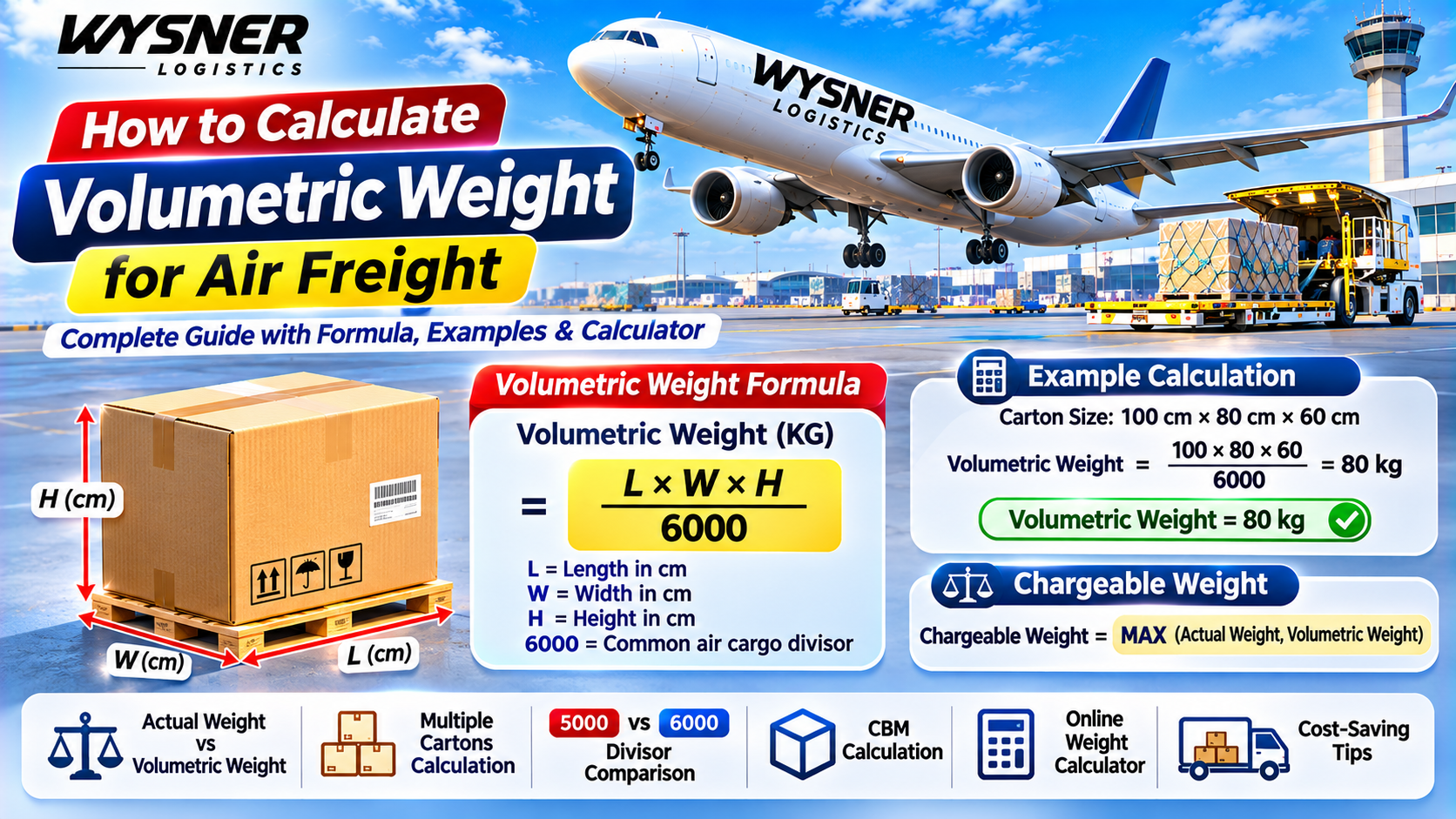
Volumetric Weight Calculation for Air Freight: Formula, Examples & Calculator
Learn how to calculate air freight volumetric weight, understand chargeable weight, compare the 5000 and 6000 divisors, and estimate your international shipping costs.
When shipping goods internationally by air, many importers and exporters assume that freight charges are calculated only according to the actual weight of their cargo. However, this is not always the case.
Air freight charges are generally calculated using chargeable weight, which considers both the actual gross weight and the volumetric weight of the shipment.
This is particularly important when shipping lightweight but bulky goods such as garments, furniture, plastic products, packaging materials, footwear, toys and other large-volume cargo.
Understanding volumetric weight calculation for air freight helps businesses estimate shipping costs, compare freight quotations and avoid unexpected charges.
1. What Is Volumetric Weight in Air Freight?
Volumetric weight, also called dimensional weight or volume weight, is the calculated weight of a shipment based on the amount of space it occupies.
Airlines have limited cargo space. A shipment containing lightweight but bulky products may occupy considerable space inside an aircraft even though its actual weight is relatively low.
For this reason, air freight providers calculate the shipment’s volumetric weight and compare it with its actual gross weight. The higher value is generally used to determine the chargeable weight.
Example
Imagine you are shipping a large carton containing plastic household products:
- Actual gross weight: 20 kg
- Volumetric weight: 45 kg
Although the cargo physically weighs only 20 kg, it occupies space equivalent to 45 kg under the applicable air freight calculation factor.
2. Volumetric Weight Calculation Formula for Air Freight
For conventional air cargo, a commonly used volumetric divisor is 6000 when dimensions are measured in centimetres and weight is expressed in kilograms.
Result = Volumetric Weight in Kilograms
Where:
- L: Length in centimetres
- W: Width in centimetres
- H: Height in centimetres
- 6000: Common air cargo volumetric divisor
Worked Calculation Example
Suppose your carton dimensions are:
- Length = 100 cm
- Width = 80 cm
- Height = 60 cm
Calculation:
The carton has a volumetric weight of 80 kg under the 6000 divisor.
3. How to Calculate Chargeable Weight for Air Freight
Chargeable weight is the weight used by the airline or freight provider to calculate freight charges.
To calculate it, compare:
- Actual gross weight
- Volumetric weight
The higher applicable weight is generally used for billing.
Example 1: Volumetric Weight Is Higher
| Description | Weight |
|---|---|
| Actual gross weight | 65 kg |
| Volumetric weight | 80 kg |
| Chargeable weight | 80 kg |
The freight calculation is based on 80 kg, subject to carrier rounding and minimum-charge rules.
Example 2: Actual Weight Is Higher
| Description | Weight |
|---|---|
| Actual gross weight | 150 kg |
| Volumetric weight | 110 kg |
| Chargeable weight | 150 kg |
In this case, the shipment is charged based on its actual gross weight.
4. Practical Volumetric Weight Calculation Examples
Let’s understand the calculation using different carton sizes commonly encountered in international air freight. The examples below use the 6000 divisor.
| Carton Dimensions (cm) | Actual Weight | Volumetric Weight | Chargeable Weight |
|---|---|---|---|
| 60 × 50 × 40 | 15 kg | 20 kg | 20 kg |
| 80 × 60 × 50 | 35 kg | 40 kg | 40 kg |
| 100 × 80 × 60 | 65 kg | 80 kg | 80 kg |
| 120 × 100 × 80 | 140 kg | 160 kg | 160 kg |
| 50 × 40 × 30 | 12 kg | 10 kg | 12 kg |
These examples show why measuring cargo correctly is important before requesting an air freight quotation.
5. How to Calculate Volumetric Weight for Multiple Cartons
If your shipment contains multiple cartons, calculate the volumetric weight of each carton and add the results together.
Example: Shipment of 10 Cartons
Suppose you have 10 identical cartons with the following dimensions:
- Length: 60 cm
- Width: 50 cm
- Height: 40 cm
- Number of cartons: 10
- Actual gross weight per carton: 15 kg
Step 1: Calculate volumetric weight of one carton.
Step 2: Multiply by the number of cartons.
Step 3: Calculate total actual gross weight.
Step 4: Determine chargeable weight.
| Description | Total |
|---|---|
| Number of cartons | 10 |
| Total actual weight | 150 kg |
| Total volumetric weight | 200 kg |
| Chargeable weight | 200 kg |
Therefore, the shipment’s chargeable weight is 200 kg before applicable carrier rounding or minimum-charge rules.
6. Difference Between 6000 and 5000 Volumetric Divisors
One of the most common sources of confusion among importers is the difference between the 6000 and 5000 volumetric divisors.
Both are used in air shipping, but they are not interchangeable. The applicable factor depends on the carrier, service and freight agreement.
| Particulars | 6000 Divisor | 5000 Divisor |
|---|---|---|
| Common application | General air cargo | Many express services |
| 1 CBM equivalent | 166.67 kg | 200 kg |
| 100 × 80 × 60 cm | 80 kg | 96 kg |
| 60 × 50 × 40 cm | 20 kg | 24 kg |
Why Does the Difference Matter?
Consider a carton measuring 100 × 80 × 60 cm.
Using 6000:
Using 5000:
The difference is 16 kg for just one carton. If you are shipping 100 cartons, this difference can significantly affect your freight budget.
7. How to Calculate Volumetric Weight in CBM
CBM stands for Cubic Metre. It is a measurement of the total volume occupied by cargo.
Dimensions in centimetres
For general air cargo using a 6000 divisor:
Example
Suppose your shipment has a total volume of 2 CBM.
At a 5000 divisor, 2 CBM would represent 400 kg volumetric weight.
8. Interactive Air Freight Volumetric Weight Calculator
Use this calculator to estimate the volumetric weight and chargeable weight of your cargo. Enter the dimensions of one carton, the total carton quantity and the total actual gross weight.
Air Freight Weight Calculator
Volumetric Weight: 0 kg
Actual Gross Weight: 0 kg
Estimated Chargeable Weight
Carrier rounding, minimum billing and other service conditions may change the final billed weight.
This calculator assumes all cartons have identical dimensions. For mixed carton sizes, calculate each carton or carton group separately and add the volumetric weights.
9. Common Mistakes When Calculating Air Freight Volumetric Weight
Many importers receive higher freight bills because the dimensions or packaging details submitted for quotation are incorrect.
1. Measuring the Product Instead of the Packed Carton
Always measure the outer dimensions of the finished package, not just the product inside it.
2. Ignoring Packaging Material
Include the outer carton, protective foam, wrapping and any protruding parts.
3. Using the Wrong Divisor
Do not automatically use 5000 or 6000. Confirm the divisor applicable to the selected air freight service.
4. Calculating Only One Carton
For multiple packages, calculate each carton or group of identical cartons and add the results.
5. Providing Incorrect Dimensions
Even a small difference in carton dimensions can affect the calculated volume, particularly for large shipments.
6. Ignoring Pallets
If cargo is shipped on pallets, the pallet’s outer dimensions and weight may affect the final calculation.
7. Confusing Net Weight with Gross Weight
Actual shipment weight generally refers to gross packed weight, including packaging, rather than just the net weight of the goods.
10. How to Reduce Volumetric Weight and Save Air Freight Costs
If your shipment has a high volumetric weight, consider these practical steps before dispatch.
- Use appropriately sized cartons: Avoid unnecessarily large boxes.
- Improve product packing: Arrange goods efficiently without compromising protection.
- Remove unnecessary empty space: Reduce excessive voids and oversized packaging.
- Use compact packaging: Where suitable, consider vacuum packing, folding or nesting products.
- Consolidate shipments carefully: Combine cargo from multiple suppliers when this makes logistical and financial sense.
- Check carton dimensions before dispatch: Ask your supplier or warehouse to provide final packed dimensions.
- Compare freight options: Obtain quotations from different carriers using the same dimensions, weight and divisor assumptions.
Remember that reducing packaging must never compromise cargo safety, product quality or regulatory requirements.
11. Difference Between Actual Weight, Volumetric Weight and Chargeable Weight
These three terms are frequently used in international air freight.
| Term | Meaning |
|---|---|
| Actual Weight | Physical gross weight of the packed shipment. |
| Volumetric Weight | Calculated weight based on cargo dimensions. |
| Chargeable Weight | Higher applicable value used for freight billing. |
Understanding these terms helps importers evaluate freight quotations correctly and avoid confusion when comparing different logistics providers.
12. Why Volumetric Weight Matters When Importing from China to India
China-to-India air freight is widely used for commercial shipments, samples, spare parts, electronics, accessories, industrial components and other products.
For importers shipping from China, volumetric weight can significantly influence the final freight cost.
Practical Example: Guangzhou to Delhi
An importer is shipping 50 cartons from Guangzhou to Delhi.
- Carton dimensions: 60 × 50 × 40 cm
- Number of cartons: 50
- Actual gross weight per carton: 15 kg
- Total actual gross weight: 750 kg
Using the 6000 divisor:
Volumetric weight per carton
Total volumetric weight
| Particulars | Weight |
|---|---|
| Total cartons | 50 |
| Total actual weight | 750 kg |
| Total volumetric weight | 1,000 kg |
| Chargeable weight | 1,000 kg |
In this example, the shipment will generally be billed at 1,000 kg rather than 750 kg, subject to the carrier’s applicable terms.
This is why importers should calculate volumetric weight before confirming a shipment booking.
13. How WYSNER LOGISTICS Helps with Air Freight Shipments
At WYSNER LOGISTICS, we understand that accurate cargo measurements and freight calculations are essential for managing international shipping costs.
We assist businesses with international freight forwarding and shipping coordination, including:
- China to India air freight
- China to India air freight consolidation
- International air cargo shipping
- Supplier pickup and cargo consolidation
- Shipment measurement and chargeable weight assessment
- Import documentation coordination
- Customs clearance coordination
- Door-to-door shipping arrangements, subject to service availability
Whether you are shipping 50 kg, 100 kg, 500 kg or several tonnes of commercial cargo, understanding the chargeable weight helps you plan your logistics budget.
Need an Air Freight Quotation?
Share your cargo dimensions, actual weight, carton quantity, origin and destination with our team to request a customized freight quotation.
WYSNER LOGISTICS
International Freight Forwarding & Cargo Consolidation
WhatsApp: +91 9654 399 399
Frequently Asked Questions (FAQs)
1. What is the formula for volumetric weight calculation in air freight?
The commonly used general air cargo formula is Length (cm) × Width (cm) × Height (cm) ÷ 6000. The applicable divisor must be confirmed with the airline or freight forwarder.
2. Why is volumetric weight important in air freight?
It measures how much aircraft cargo space a shipment occupies. Airlines and freight providers use it alongside actual weight to determine chargeable weight.
3. Is volumetric weight the same as dimensional weight?
Yes. Volumetric weight, dimensional weight and volume weight are commonly used terms for calculating shipment weight based on package dimensions.
4. What is the difference between 5000 and 6000 in air freight?
These are different volumetric divisors. A 5000 divisor produces a higher volumetric weight than a 6000 divisor for the same dimensions. General air cargo commonly uses 6000, while many express courier services use 5000.
5. How much is 1 CBM in air freight?
Using a 6000 divisor, 1 CBM is approximately 166.67 kg of volumetric weight. Using a 5000 divisor, 1 CBM is 200 kg.
6. How do I calculate volumetric weight for 10 cartons?
Calculate the volumetric weight of one carton and multiply it by 10 if all cartons have identical dimensions. If the cartons have different dimensions, calculate each separately and add their volumetric weights.
7. Is air freight charged on actual weight or volumetric weight?
Generally, air freight is charged on the higher of actual gross weight and volumetric weight. Carrier-specific rounding, minimum charges and other pricing conditions may apply.
8. Does packaging affect volumetric weight?
Yes. The outer dimensions of the packed shipment are used. Larger cartons, excess packaging and pallets can increase volumetric weight.
9. What is the volumetric weight of 100 × 80 × 60 cm?
Using the 6000 divisor: 100 × 80 × 60 ÷ 6000 = 80 kg. The volumetric weight is 80 kg.
10. How can I reduce air freight charges?
Use suitable carton sizes, optimize packaging, reduce unnecessary empty space, consolidate shipments where appropriate and compare carrier quotations using the correct divisor.
Conclusion
Understanding volumetric weight calculation for air freight is essential for every importer, exporter and business involved in international cargo transportation.
The key points to remember are:
- Measure the outer dimensions of the packed cargo.
- Use the correct volumetric divisor.
- Calculate the volumetric weight for every carton.
- Compare volumetric weight with actual gross weight.
- Use the higher applicable value to estimate chargeable weight.
- Confirm carrier-specific rounding and billing conditions.
Correct calculations before dispatch can help you avoid unexpected freight costs and make better shipping decisions.
Need reliable air freight services for your international shipments? Contact WYSNER LOGISTICS today.
WYSNER LOGISTICS
Connecting Global Trade. Simplifying International Shipping.
WhatsApp: +91 9654 399 399
Disclaimer: Volumetric calculation examples are illustrative. Actual chargeable weight and freight billing are subject to the selected airline, carrier, freight agreement, measurement rules, rounding and minimum charges. Always confirm the final calculation with your freight forwarder.
Read More: How to import from China to India | how to import from uk to india | how to import from USA to India | how to import from Vietnam to India | how to import from South Korea to India
