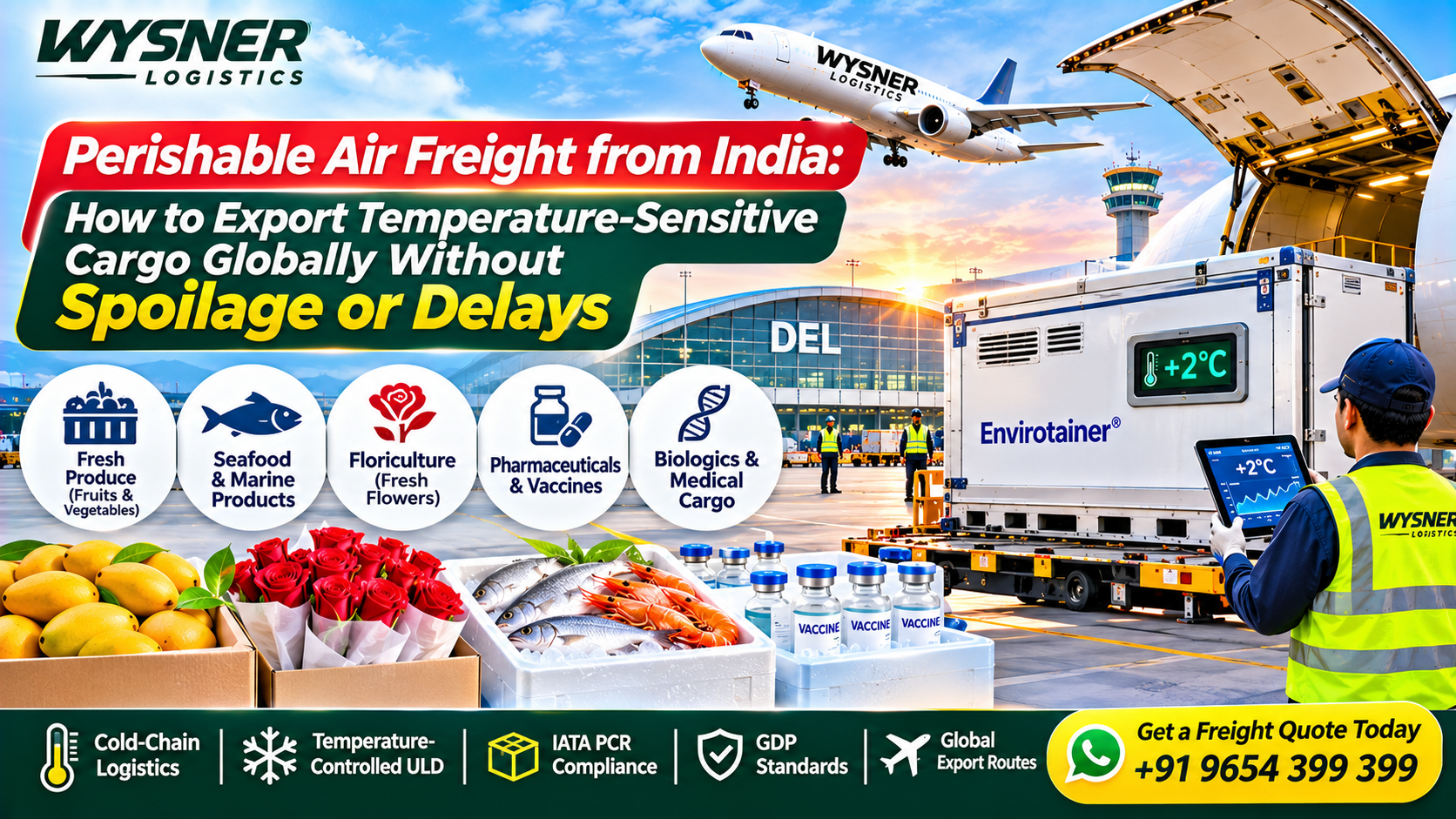
Perishable Air Freight from India: How to Export Temperature-Sensitive Cargo Globally Without Spoilage
India is an important supplier of fresh agricultural products, seafood, flowers, pharmaceutical products and other temperature-sensitive commodities. International buyers depend on exporters who can deliver these products while maintaining their quality, safety and required temperature conditions.
However, exporting perishable products is more complicated than booking an ordinary air cargo shipment. Fresh fruits can lose quality, flowers can wilt, seafood can deteriorate and pharmaceutical products can become unsuitable for use if temperature requirements are not maintained.
This is why perishable air freight from India requires coordinated cold-chain logistics, suitable packaging, airline selection, airport cold storage, accurate documentation and timely customs clearance.
Whether you are exporting mangoes to the Middle East, seafood to Europe, flowers to international markets or pharmaceutical products to the USA, every stage of transportation must be planned around the product’s specific requirements.
WYSNER LOGISTICS provides international freight forwarding and logistics coordination for businesses exporting and importing commercial cargo, subject to cargo eligibility, route availability and operational requirements.
Quick Answer: How to Export Perishable Cargo from India Without Spoilage
To export temperature-sensitive cargo safely from India:
- Identify the exact product temperature requirements.
- Confirm export eligibility and destination import regulations.
- Select suitable insulated or temperature-controlled packaging.
- Pre-cool or condition cargo where required.
- Select an appropriate airport, airline and route.
- Confirm cold storage and cargo acceptance arrangements.
- Prepare export documents and applicable certificates.
- Arrange suitable transportation to the airport.
- Minimize unnecessary waiting and handling.
- Coordinate customs clearance and destination delivery in advance.
- Use appropriate temperature monitoring where required.
The most important rule is to maintain the required temperature throughout the supply chain, not just during the aircraft journey.
Exporting Perishables from India by Air: Cold-Chain Logistics, Airport Hubs & Fast Customs Clearance
Exporting perishable products from India requires coordination between the exporter, supplier, packaging company, freight forwarder, airline, airport cargo terminal, customs broker and overseas consignee.
What Is Perishable Air Freight?
Perishable air freight refers to the transportation of products that can deteriorate, spoil or lose commercial value because of unsuitable temperatures, humidity, handling conditions or transportation delays.
- Fresh fruits and vegetables
- Fresh flowers and ornamental plants
- Seafood and marine products
- Chilled and frozen meat
- Dairy products
- Frozen food
- Pharmaceutical products
- Vaccines and biological materials
- Temperature-sensitive healthcare products
How Does the Cold Chain Work?
A cold chain is a coordinated supply-chain system designed to maintain specified environmental conditions during storage, transportation and handling.
- Farm, factory, laboratory or processing facility.
- Initial cooling or temperature conditioning.
- Packaging and quality inspection.
- Refrigerated transportation to the airport.
- Export cargo acceptance.
- Temperature-controlled airport storage, where available.
- Aircraft loading and international transportation.
- Transit handling, if applicable.
- Destination airport cold storage.
- Customs clearance and final delivery.
Why Is Fast Customs Clearance Important?
Perishable products have a limited commercial shelf life. Delays in documentation, examination or regulatory approvals can affect the product’s remaining shelf life.
Common export documents may include commercial invoices, packing lists, Shipping Bills, Air Waybills, certificates of origin, phytosanitary certificates, health certificates and product-specific approvals.
Review the official APEDA export documentation guidance for information about commonly used export documents.
Complete documentation and advance coordination can help reduce avoidable delays. Actual clearance remains subject to Customs and other competent authorities.
Air Cargo for Indian Perishable Exporters: Rates, Cold Storage & Global Trade Lanes
Air freight is frequently selected for Indian perishable exports because it can reduce transportation time and connect exporters with international markets.
What Determines Perishable Air Freight Rates from India?
There is no universal per-kilogram price for every perishable shipment. Freight rates depend on several factors.
| Pricing Factor | How It Affects the Cost |
|---|---|
| Actual gross weight | Physical weight of the shipment. |
| Volumetric weight | Space occupied by the cargo. |
| Chargeable weight | Weight used for freight calculation. |
| Cargo category | Different products have different handling requirements. |
| Temperature requirement | Specialised handling may increase costs. |
| Origin airport | Airport and handling charges differ. |
| Destination airport | Route and destination handling affect the price. |
| Airline availability | Rates depend on capacity and schedules. |
| Packaging | Insulated or specialised packaging adds cost. |
| Refrigerants | Dry ice or other approved materials may add charges. |
| Customs and delivery | Clearance and final delivery are additional cost components. |
For many air freight services, chargeable weight is determined by comparing actual gross weight with volumetric weight. The applicable calculation method must be confirmed with the airline or freight forwarder.
What Should an Air Freight Quotation Include?
- Origin airport handling
- Export documentation
- Security screening
- International air freight
- Fuel and applicable surcharges
- Special cargo handling
- Cold storage, if applicable
- Refrigerant handling, if applicable
- Destination handling
- Customs clearance arrangements
- Final delivery
A low air freight rate does not automatically mean a low total shipping cost. Compare all origin, freight, destination and delivery charges.
Major Global Trade Lanes for Indian Perishable Exports
Middle East
Dubai, Abu Dhabi, Doha, Riyadh, Jeddah, Muscat and Kuwait City.
Europe
London, Amsterdam, Frankfurt, Paris, Brussels and Milan.
North America
New York, Chicago, Los Angeles, San Francisco and Toronto.
Asia-Pacific
Singapore, Hong Kong, Bangkok, Kuala Lumpur and Tokyo.
These are potential destination markets, not guaranteed direct routes. Actual routing depends on airline schedules, cargo acceptance, transit availability and import restrictions.
The Indian Exporter’s Guide to Perishable Air Freight: IATA PCR Rules, Cold Rooms & Packaging
International perishable cargo transportation requires suitable packaging, handling, documentation and coordination.
The IATA Perishable Cargo Regulations (PCR) provide industry rules and guidance for the transportation of perishable goods by air.
What Does IATA PCR Cover?
- Shipper and carrier responsibilities
- Packaging requirements
- Booking and acceptance procedures
- Documentation and labelling
- Cargo handling operations
- Ground transportation
- Traceability and tracking
- Quality and risk management
- Delivery procedures
- Commodity-specific considerations
Exporters should consult the current edition and applicable airline variations before shipping. Following PCR procedures is not the same as holding a separate IATA certification.
Cold Storage Requirements
Cold storage facilities may provide chilled storage, frozen storage, controlled-room-temperature storage, separate chambers, temperature monitoring and refrigerated loading arrangements.
The required storage temperature depends on the product. Pharmaceutical cargo should not automatically be stored in a chamber intended for fresh produce.
Packaging Requirements
Packaging must protect products from temperature fluctuations, physical damage, moisture loss, excessive condensation, contamination, leakage and crushing.
Packaging should be selected according to the product, expected transportation duration, route and handling conditions.
How to Ship Fresh Produce, Seafood & Pharma from India by Air: A Complete Cold-Chain Guide
A. Shipping Fresh Fruits and Vegetables from India
India exports mangoes, grapes, pomegranates, bananas, vegetables, herbs and other agricultural products to international markets.
Important requirements include:
- Harvesting at the appropriate maturity stage.
- Pre-cooling where required.
- Grading and sorting.
- Suitable export packaging.
- Product-specific temperature management.
- Phytosanitary compliance where applicable.
- Destination-country import compliance.
B. Shipping Seafood from India by Air
India is an important exporter of marine products, including frozen shrimp, fish, squid and other seafood.
Seafood is sensitive to temperature, hygiene and handling conditions. The correct shipping arrangement depends on whether the product is fresh, chilled, frozen, live or processed.
- Appropriate processing and hygiene controls.
- Suitable chilled or frozen packaging.
- Leakage prevention.
- Temperature monitoring where required.
- Health and inspection certificates where applicable.
- Destination-country import compliance.
C. Pharmaceutical Air Freight from India
Pharmaceutical products may require carefully controlled storage and transportation conditions. The exact temperature requirements are determined by the manufacturer, product stability data and applicable regulations.
- Manufacturer-approved temperature range.
- Qualified packaging.
- Temperature monitoring.
- Route risk assessment.
- Documented handling procedures.
- Appropriate storage facilities.
- Deviation reporting.
- Destination delivery planning.
D. Shipping Flowers and Floriculture Products
Indian exporters may ship roses, carnations, orchids, chrysanthemums and other ornamental products to international markets.
Fresh flowers require careful post-harvest handling, species-specific temperature requirements, appropriate hydration, packaging, ventilation, moisture management and fast airport handling.
Top Perishable Commodities Exported from India (Produce, Seafood, Floriculture, Pharma)
1. Fresh Fruits
Important products include mangoes, grapes, pomegranates, bananas and other seasonal fruits. Fresh fruits may require pre-cooling, grading, suitable packaging and product-specific temperature control.
2. Fresh Vegetables
Common products include green chillies, okra, bitter gourd, drumsticks, beans and leafy vegetables. The correct temperature and packaging depend on the vegetable variety.
3. Seafood and Marine Products
Important products include frozen shrimp, fish, squid, cuttlefish, crab and other marine products. Seafood exports require appropriate hygiene, processing, inspection, documentation and temperature management.
4. Floriculture Products
Roses, carnations, orchids, chrysanthemums, gerberas and cut foliage are among the products that may require specialised perishable air freight arrangements.
5. Pharmaceutical and Healthcare Products
Temperature-sensitive medicines, vaccines, biological products and selected healthcare materials require product-specific handling and regulatory compliance.
6. Frozen and Processed Food Products
Frozen vegetables, seafood, prepared foods and selected dairy products require transportation conditions appropriate to their storage specifications.
Major Indian Air Cargo Hubs with Cold-Chain Infrastructure (DEL, BOM, BLR, MAA, HYD)
Selecting the correct airport is important for perishable air freight planning. India has several international airports serving agricultural, pharmaceutical and temperature-sensitive cargo.
However, cold storage availability, handling capacity, temperature ranges and airline services vary by facility. Confirm the actual arrangements before booking.
1. Delhi – Indira Gandhi International Airport (DEL)
Delhi is an important air cargo gateway for North India.
Delhi Airport’s official cargo services page describes its temperature-control cargo terminal, separate temperature chambers, insulated loading and unloading bays and cool dollies for cargo movement.
Potential export commodities include fresh fruits, vegetables, flowers, pharmaceutical products and other eligible temperature-sensitive goods.
2. Mumbai – Chhatrapati Shivaji Maharaj International Airport (BOM)
Mumbai is an important international cargo gateway serving western India. Exporters should confirm perishable cargo acceptance, available cold storage, temperature range, airline handling, export cut-off time and destination routing.
3. Bengaluru – Kempegowda International Airport (BLR)
Bengaluru is a significant air cargo hub for pharmaceutical and perishable products.
The AISATS official website provides information about its COOLPORT specialised cold-chain facility. Confirm current operating specifications, temperature range and available capacity directly with the facility.
4. Chennai – Chennai International Airport (MAA)
Chennai is an important international cargo gateway for southern India.
The Airports Authority of India – Chennai Airport Cargo Facilities page describes perishable cargo storage at the export facility and temperature-controlled storage at the import facility.
5. Hyderabad – Rajiv Gandhi International Airport (HYD)
Hyderabad is an important international airport serving exporters in Telangana, Andhra Pradesh and nearby regions. It may be considered for pharmaceutical, healthcare, agricultural and other temperature-sensitive shipments.
Confirm the actual cold-chain storage availability, airline handling arrangements, accepted temperature ranges and destination connectivity for your cargo.
| Airport | Code | Planning Consideration |
|---|---|---|
| Delhi IGI | DEL | Published temperature-controlled cargo infrastructure. |
| Mumbai | BOM | International cargo gateway for western India. |
| Bengaluru | BLR | AISATS COOLPORT specialised cold-chain facility. |
| Chennai | MAA | AAI-listed perishable cargo storage facility. |
| Hyderabad | HYD | Confirm route and specialised handling capabilities. |
Airport infrastructure does not automatically guarantee that a particular airline or flight has cold-storage capacity available for your shipment. Obtain confirmation before dispatch.
Step-by-Step Export Process: APEDA/MPEDA Compliance, Packaging & Customs Clearance
Step 1: Obtain Importer Exporter Code (IEC)
Indian businesses generally require an Importer Exporter Code issued by the Directorate General of Foreign Trade for commercial export activities, subject to applicable exemptions. Visit the official DGFT website for current requirements.
Step 2: Check APEDA Requirements for Agricultural Products
APEDA supports the development and export promotion of scheduled agricultural and processed food products.
Depending on the product and export activity, exporters may need APEDA registration and a Registration-cum-Membership Certificate (RCMC).
Read APEDA’s official website and its export documentation guidance to understand the applicable product and documentation requirements.
Step 3: Check MPEDA Requirements for Seafood Exports
Marine product exporters must consider the registration and approval requirements administered by the Marine Products Export Development Authority.
Visit the MPEDA Exporters Portal for registration information and steps to obtain MPEDA exporter registration.
Seafood exporters should also confirm the applicable Export Inspection Agency approvals and processing-facility requirements.
Step 4: Verify Destination-Country Import Requirements
- Import eligibility and restrictions.
- Product-specific food safety requirements.
- Plant health requirements.
- Health certificates.
- Testing and inspection requirements.
- Packaging and labelling rules.
- Importer registrations.
- Customs documentation.
Step 5: Arrange Product Preparation and Quality Inspection
Prepare the goods according to the overseas buyer’s specifications. This may include grading, sorting, pre-cooling, processing, inspection and packing.
Step 6: Select Suitable Packaging
Choose packaging according to the product, required temperature range, shipment duration, route, ambient conditions and airline handling requirements.
Step 7: Prepare Export Documentation
| Document | Purpose |
|---|---|
| IEC | Exporter identification and registration, where required. |
| Commercial Invoice | Transaction and product value. |
| Packing List | Package quantity, weight and dimensions. |
| Shipping Bill | Export customs declaration. |
| Air Waybill | International air transport document. |
| Certificate of Origin | Origin evidence, where required. |
| Phytosanitary Certificate | Plant health certification, where applicable. |
| Health Certificate | Product-specific health documentation. |
| Inspection Certificate | Required inspection evidence, where applicable. |
| Other Approvals | Commodity-specific registrations and permissions. |
Not every document applies to every shipment. Confirm the exact requirements for the commodity and destination.
Step 8: Book International Air Freight
Share the cargo details with your freight forwarder. Confirm the airline, flight schedule, temperature requirements, cargo acceptance deadline, transit airport, destination handling and total freight cost.
Step 9: Complete Customs Clearance
The exporter or its authorised Customs Broker coordinates the export declaration and applicable formalities. The process may include document verification, assessment, examination where ordered and grant of Let Export Order (LEO).
Step 10: Final Delivery and Shipment Monitoring
After arrival, the overseas importer should arrange customs clearance, suitable storage and final delivery. Temperature records and shipment documents should be retained according to the product’s quality requirements.
How to Get an Expedited Perishable Air Freight Quote
When shipping fresh produce, seafood, flowers or pharmaceutical cargo, a standard freight quotation may not be sufficient. An expedited quotation should include the operational requirements that affect shipment acceptance and transportation.
Information Required for a Perishable Air Freight Quote
| Required Detail | Example |
|---|---|
| Product | Fresh mangoes |
| Origin airport | Delhi (DEL) |
| Destination airport | Dubai (DXB) |
| Gross weight | 500 kg |
| Number of cartons | 100 |
| Carton dimensions | 60 × 40 × 30 cm |
| Required temperature | As specified for the product |
| Packaging | Ventilated export cartons |
| Cargo-ready date | Expected dispatch date |
| Special handling | Chilled cargo, if required |
| Documentation | Applicable export certificates |
What Should an Expedited Quotation Confirm?
- Airline and route availability.
- Available cargo capacity.
- Temperature-controlled handling availability.
- Cargo acceptance cut-off.
- Export documentation requirements.
- Applicable freight and handling charges.
- Transit time and connection details.
- Destination handling arrangements.
- Customs and final delivery responsibilities.
Expedited service does not automatically mean priority customs clearance or guaranteed delivery. Those conditions must be confirmed separately.
Expedited Cold Chain Air Cargo: A Shipper’s Guide to Booking, Packaging, and Customs
Expedited cold-chain shipping is useful when cargo has a short shelf life, strict delivery schedule or high commercial value. Booking the fastest available flight is only one part of the process.
Booking the Correct Airline and Route
Evaluate direct flight availability, transit time, flight frequency, cargo capacity, perishable handling capability, cold storage at transit airports and destination terminal facilities.
Preparing the Packaging
Possible packaging options include insulated cartons, thermal liners, gel packs, refrigerants, dry ice where suitable and permitted, qualified passive temperature-controlled packaging and active temperature-controlled containers.
Customs Preparation
Review customs documentation before cargo acceptance. Missing certificates or incorrect product details can delay cargo release even when the airline booking is confirmed.
Contingency Planning
Plan for flight delays, schedule changes, missed connections, additional customs documents, examination and unavailable destination storage.
How to Book Perishable Air Cargo: Rates, Cold-Chain Rules, and Transit Times
- Confirm the commodity: Identify whether the cargo is fresh, chilled, frozen, pharmaceutical or another temperature-sensitive product.
- Provide weight and dimensions: Share the number of packages, gross weight and dimensions of every carton.
- Confirm temperature requirements: Provide the exact temperature range and handling instructions.
- Confirm packaging: State whether the shipment uses insulation, refrigerants, dry ice or active equipment.
- Select the route: Compare flight availability, transit time, connections and handling capabilities.
- Review the quotation: Check all included and excluded charges.
- Complete documentation: Prepare invoices, packing lists, Shipping Bills and applicable certificates.
- Confirm cargo acceptance: Do not dispatch until the airline or handling agent confirms acceptance requirements.
Understanding Perishable Air Freight Transit Times
Transit time is influenced by flight schedules, direct or connecting routes, cargo acceptance cut-offs, airport handling, customs clearance and destination delivery.
The flight duration is not the same as the total door-to-door transportation time. Always request a shipment-specific transit estimate.
Shipping Fresh Produce & Seafood by Air: Cold-Chain Logistics Explained
Fresh Produce Cold-Chain Management
Fresh produce can deteriorate due to high temperatures, dehydration, excessive moisture, ethylene exposure, incorrect ventilation, physical damage and transportation delays.
Exporters should select packaging and storage conditions according to the product’s variety, maturity, shelf life and destination.
Seafood Cold-Chain Management
Seafood requires strict hygiene and product-specific temperature management. Fresh, chilled and frozen seafood must be clearly distinguished when arranging air freight.
Frozen seafood must remain within its specified frozen condition. Chilled seafood requires a different handling and packaging arrangement.
| Requirement | Fresh Produce | Seafood |
|---|---|---|
| Main risk | Ripening, dehydration and bruising | Temperature abuse and contamination |
| Packaging | Ventilated or protective packaging as appropriate | Leak-resistant and hygienic packaging |
| Temperature | Variety-specific | Product-specific chilled or frozen condition |
| Monitoring | Based on shipment risk | Important for sensitive cargo |
| Documentation | Plant health and export documents, where required | Health, processing and export documents, where required |
Why Is Airport Dwell Time Important?
Cargo may be exposed to unsuitable conditions while waiting for acceptance, security screening, loading or transfer. Reducing unnecessary waiting time is important for both produce and seafood.
Pharmaceutical & Perishable Air Freight: Meeting IATA PCR & GDP Standards
Pharmaceutical products require a carefully managed supply chain because temperature deviations can affect product quality and stability.
What Is GDP in Pharmaceutical Logistics?
Good Distribution Practice (GDP) refers to quality principles and procedures intended to protect the integrity of medicinal products during distribution.
- Temperature mapping.
- Qualified storage facilities.
- Validated packaging.
- Equipment calibration.
- Trained personnel.
- Route risk assessment.
- Documented handling procedures.
- Temperature monitoring.
- Deviation management.
- Corrective and preventive actions.
What Is IATA CEIV Pharma?
IATA’s CEIV Pharma programme assesses pharmaceutical logistics organisations and their operational capabilities. Certification can provide assurance about defined quality, infrastructure and handling standards, but it must be verified for the actual organisation and service involved.
Visit IATA’s Pharma and Healthcare Cargo resources for further information.
PCR and Pharmaceutical Cargo Are Not the Same Thing
IATA PCR focuses on perishable cargo, while pharmaceutical transportation has additional requirements addressed by applicable pharmaceutical handling regulations and quality systems. A pharmaceutical shipment should not be treated as ordinary fresh produce simply because both require temperature control.
7 Costly Mistakes in Perishable Air Shipments (And How to Keep Your Cold Chain Intact)
Mistake 1: Selecting the Wrong Temperature
Using an incorrect temperature can damage the cargo. Solution: Obtain written product-specific temperature instructions.
Mistake 2: Using Ordinary Packaging
Ordinary cartons may not protect temperature-sensitive products during long transportation journeys. Solution: Use suitable insulated or qualified packaging.
Mistake 3: Skipping Pre-Cooling
Loading products before the required initial temperature has been achieved can compromise the cold chain. Solution: Complete appropriate pre-cooling or conditioning before dispatch.
Mistake 4: Booking Without Confirming Cold Storage
A flight booking does not automatically guarantee temperature-controlled storage at origin, transit or destination. Solution: Obtain confirmation of the relevant storage and handling arrangements.
Mistake 5: Incomplete Export Documentation
Missing certificates, incorrect product descriptions or incomplete declarations can delay cargo release. Solution: Review documentation before dispatch.
Mistake 6: Choosing a Route Only on Price
A cheaper flight with a long connection or unsuitable transit handling may create additional risk. Solution: Compare total transit time, connection risk and handling capabilities.
Mistake 7: No Contingency Plan
A flight delay or customs examination can become a major problem if nobody is responsible for managing the shipment. Solution: Define escalation contacts, alternate arrangements and destination receiving plans before departure.
From Farm to Tarmac: How Refrigerated Air Cargo Protects High-Value Perishables
The quality of a perishable shipment is influenced by what happens before it reaches the airport. The cold chain should begin at the farm, processing facility or manufacturing location.
- Production and harvesting: Products are harvested or manufactured according to their quality and handling requirements.
- Initial conditioning: Products are cooled or conditioned where required.
- Grading and quality control: Products are checked for defects, contamination and damage.
- Packaging: Suitable packaging protects cargo during handling and transportation.
- Refrigerated transportation: Cargo moves in refrigerated vehicles or suitable insulated systems where required.
- Airport cargo acceptance: The shipment is presented according to airline and terminal requirements.
- Cold storage and aircraft loading: Confirmed temperature-controlled arrangements help protect the cargo before loading.
- International air transportation: Cargo travels on the selected flight and through planned transit points.
- Destination handling: The destination handler coordinates cargo receipt, storage and release.
- Final delivery: Cargo moves to the consignee’s appropriate storage or distribution facility.
An aircraft cannot reverse damage that occurred before the cargo reached the airport. Cold-chain planning must therefore begin at the source.
Exporting Perishables from India by Air: Cold Storage, IATA Rules, and Key Trade Lanes
Indian exporters can use several international air cargo gateways depending on the product’s origin, destination and airline availability.
Important Export Planning Considerations
- Distance from the farm or production facility.
- Availability of pre-cooling infrastructure.
- Refrigerated road transportation.
- Export cargo terminal facilities.
- Airline network and direct flight availability.
- Destination cold storage.
- Customs and regulatory arrangements.
- Total freight and handling costs.
Important International Trade Lanes
India to Middle East: Suitable routes may support fresh produce, flowers, seafood and other eligible temperature-sensitive products.
India to Europe: Potential markets include the UK, Netherlands, Germany, France and other European destinations, subject to import regulations.
India to USA: Pharmaceutical products, fresh produce and other eligible cargo may require carefully coordinated routes and destination compliance.
India to Southeast Asia: Selected agricultural products, seafood and other perishable goods may move through suitable regional air cargo networks.
Always confirm product eligibility, airline acceptance and current routing before committing to an export schedule.
How to Calculate the Cost of Perishable Air Freight from India
The total cost of exporting perishable goods is not limited to the international air freight rate.
| Cost Component | Description |
|---|---|
| Product preparation | Harvesting, sorting, grading or processing. |
| Pre-cooling | Initial cooling or conditioning. |
| Packaging | Insulated cartons and protective materials. |
| Refrigerated pickup | Transportation to the airport. |
| Origin handling | Cargo terminal and export handling. |
| Security screening | Applicable screening charges. |
| International air freight | Airline transportation charges. |
| Special handling | Perishable or temperature-controlled handling. |
| Refrigerants | Gel packs, dry ice or other approved materials. |
| Export documentation | Certificates and processing charges. |
| Customs clearance | Customs broker service charges. |
| Destination handling | Airport storage and cargo release. |
| Final delivery | Transportation to the buyer or warehouse. |
Actual Weight and Volumetric Weight
Air freight is generally calculated on chargeable weight. Chargeable weight is commonly the greater of actual gross weight and volumetric weight. The applicable calculation method must be confirmed with the airline or freight forwarder.
For insulated packaging, remember that thermal protection may increase package dimensions and therefore volumetric weight.
How to Reduce Perishable Air Freight Costs
- Select the correct origin airport.
- Plan shipments around confirmed airline capacity.
- Optimise packaging dimensions without compromising protection.
- Avoid unnecessary storage and handling.
- Consolidate compatible shipments where practical.
- Prepare documents before cargo dispatch.
- Compare total landed costs rather than headline freight rates.
- Select a route that balances price, speed and cold-chain risk.
Do not reduce refrigerant, insulation or packaging below the level required to protect the product just to save freight costs.
How to Choose the Right Perishable Air Freight Forwarder in India
A suitable freight forwarding partner can help coordinate multiple parties involved in international perishable transportation.
1. Perishable Cargo Experience
Ask whether the company has experience coordinating your specific commodity.
2. Airline and Route Knowledge
Check whether it can evaluate suitable airline services and transit routes.
3. Cold Storage Coordination
Confirm whether the relevant airport and cargo terminal offer the required temperature-controlled facilities.
4. Packaging Knowledge
Ask whether the team can coordinate with suitable packaging specialists.
5. Documentation Support
The forwarder should understand the documentation required for your product and destination.
6. Customs Coordination
Confirm whether it can coordinate with the appropriate authorised Customs Broker.
7. Shipment Communication
Clear updates are important when cargo has a short shelf life.
8. Contingency Planning
Ask what arrangements are available in the event of flight delays, missed connections or customs holds.
9. Certification Verification
If the shipment requires GDP, CEIV or other specialised handling, verify the actual certification and scope of the organisations involved.
A freight forwarder should not claim to hold a certification simply because it books cargo with a certified airline or terminal.
Why Choose WYSNER LOGISTICS for International Air Freight Coordination?
WYSNER LOGISTICS, operated by WYSNER GLOBAL INC, provides international freight forwarding and logistics coordination for businesses exporting and importing commercial cargo.
We understand that international shipping involves more than arranging an airline booking. Exporters need accurate cargo information, route planning, documentation coordination and communication among multiple logistics stakeholders.
International Air Freight
Air cargo transportation arrangements for eligible commercial shipments.
International Sea Freight
LCL and FCL shipping coordination.
Import and Export Logistics
International shipment and documentation coordination.
Cargo Consolidation
Coordination of compatible cargo from multiple suppliers.
Supplier Pickup Coordination
Pickup and cargo receiving arrangements from supplier locations.
Customs Coordination
Coordination with appropriate authorised customs professionals.
Perishable Air Freight Enquiries
If you are planning to export fresh produce, seafood, flowers, pharmaceutical products or other temperature-sensitive cargo, we can discuss your shipping requirements and evaluate possible freight arrangements.
The following information is useful:
- Commodity name
- Required temperature range
- Origin city and airport
- Destination city and airport
- Actual gross weight
- Number of packages
- Dimensions of each package
- Packaging type
- Refrigerant requirements, if applicable
- Cargo-ready date
- Required delivery date
- Export certificates and approvals, where applicable
Frequently Asked Questions About Perishable Air Freight from India
1. What is perishable air freight from India?
It is the international transportation of temperature-sensitive products such as fruits, vegetables, seafood, flowers, frozen food and pharmaceutical products using suitable air cargo services.
2. Which products can be exported from India by perishable air freight?
Eligible products may include mangoes, grapes, pomegranates, fresh vegetables, seafood, flowers, frozen food and pharmaceutical products. Export eligibility depends on the product and destination-country requirements.
3. Which Indian airports handle perishable air cargo?
Important airports to evaluate include Delhi (DEL), Mumbai (BOM), Bengaluru (BLR), Chennai (MAA) and Hyderabad (HYD). Cold storage and specialised handling availability must be confirmed for the specific terminal and airline.
4. What is IATA PCR?
IATA Perishable Cargo Regulations provide industry rules and guidance for packaging, booking, documentation, handling and transportation of perishable goods by air.
5. Is APEDA registration required for all agricultural exports?
No. APEDA registration requirements depend on the product category and applicable export promotion rules. Exporters should verify whether their product falls under APEDA’s scheduled products and what registration is required.
6. Is MPEDA registration required for seafood exporters?
MPEDA states that registration as an exporter is required for marine product exports, subject to applicable statutory provisions and exceptions. Exporters should verify their category and approval requirements before shipping.
7. How long does perishable air freight from India take?
Transit time depends on origin, destination, airline schedule, direct or connecting route, cargo handling, customs clearance and final delivery. Obtain a shipment-specific transit estimate before booking.
8. How are perishable air freight rates calculated?
Rates depend on chargeable weight, cargo category, packaging, origin, destination, temperature requirements, airline capacity and additional handling charges.
9. Can fresh mangoes be exported from India by air?
Eligible fresh mangoes can be exported by air when applicable plant health, phytosanitary, quality, packaging, customs and destination-country import requirements are met.
10. Can seafood be exported from India by air?
Eligible chilled, frozen and other permitted marine products can be transported by air when applicable MPEDA, EIA, health, processing, packaging and destination requirements are met.
11. Does every perishable shipment require refrigerated packaging?
No. The correct packaging depends on product temperature sensitivity, expected journey duration, route and handling requirements. Some shipments require insulation, refrigerants or specialised active equipment.
12. What is the difference between cold storage and temperature-controlled packaging?
Cold storage refers to a controlled storage facility, while temperature-controlled packaging protects cargo during transportation. Both may be needed to maintain the cold chain.
13. Can perishable cargo be transported on connecting flights?
Yes, subject to airline acceptance and suitable transit arrangements. Confirm temperature-controlled handling at the transit airport and assess the additional risk of longer waiting times.
14. What documents are required for perishable exports from India?
Common documents include the commercial invoice, packing list, Shipping Bill and Air Waybill. Additional documents may include phytosanitary certificates, health certificates, inspection certificates, APEDA or MPEDA documentation and other product-specific approvals.
15. How can I get a perishable air freight quotation from WYSNER LOGISTICS?
Share the commodity, origin, destination, gross weight, dimensions, packaging, required temperature range and cargo-ready date with our team.
Get a Perishable Air Freight Quote from India
Exporting fresh fruits, vegetables, seafood, flowers, pharmaceutical products or other temperature-sensitive cargo?
WYSNER LOGISTICS can help evaluate your international shipping requirements and discuss suitable freight forwarding arrangements based on your cargo, destination and delivery schedule.
Send us your shipment details to discuss a freight quotation.
WYSNER LOGISTICS
International Freight Forwarding & Logistics Solutions
WhatsApp / Contact: +91 9654 399 399
Email: info@wysnerlogistics.com
Useful Official Resources for Indian Perishable Exporters
Use the following official resources to verify current export, cargo handling and industry requirements:
- IATA – Perishable Cargo Regulations (PCR): Perishable cargo packaging, handling, documentation and transportation guidance.
- IATA – Perishables Cargo Programme: Industry information and perishable cargo training.
- APEDA Official Website: Agricultural and processed food export information.
- APEDA – Export Documentation: Common export documents and export process guidance.
- MPEDA Exporters Portal: Marine product exporter registration and services.
- MPEDA – Steps to Get Exporter Registration: Seafood exporter registration process.
- DGFT Official Website: IEC and foreign trade policy information.
- Delhi Airport Cargo Services: Temperature-controlled cargo infrastructure and airport cargo services.
- AISATS – Bengaluru Cargo Services: COOLPORT cold-chain facility information.
- Airports Authority of India – Chennai Cargo Facilities: Perishable cargo storage and cargo terminal information.
Related WYSNER LOGISTICS Guides
- Freight Forwarders in Delhi – Air, Sea and International Shipping
- Customs Clearing Agent in Delhi, India – CHA and Customs Clearance
- Volumetric Weight Calculation for Air Freight
- China to India Import Agent in Delhi – Shipping and Freight Services
Disclaimer: This article provides general information about perishable air freight and export logistics from India. Export eligibility, licences, registrations, certifications, temperature requirements, packaging, customs procedures and destination-country regulations depend on the product and current applicable laws. Airport facilities, airline acceptance, transit schedules and special handling services must be confirmed before booking. This article does not constitute legal, customs, food safety, pharmaceutical or regulatory advice.
Also Read: Perishable Air Freight | China to India Import Agent in Delhi | customs clearing agent in Delhi | Freight Forwarders in Delhi. | Freight Forwarding Company Near Me
