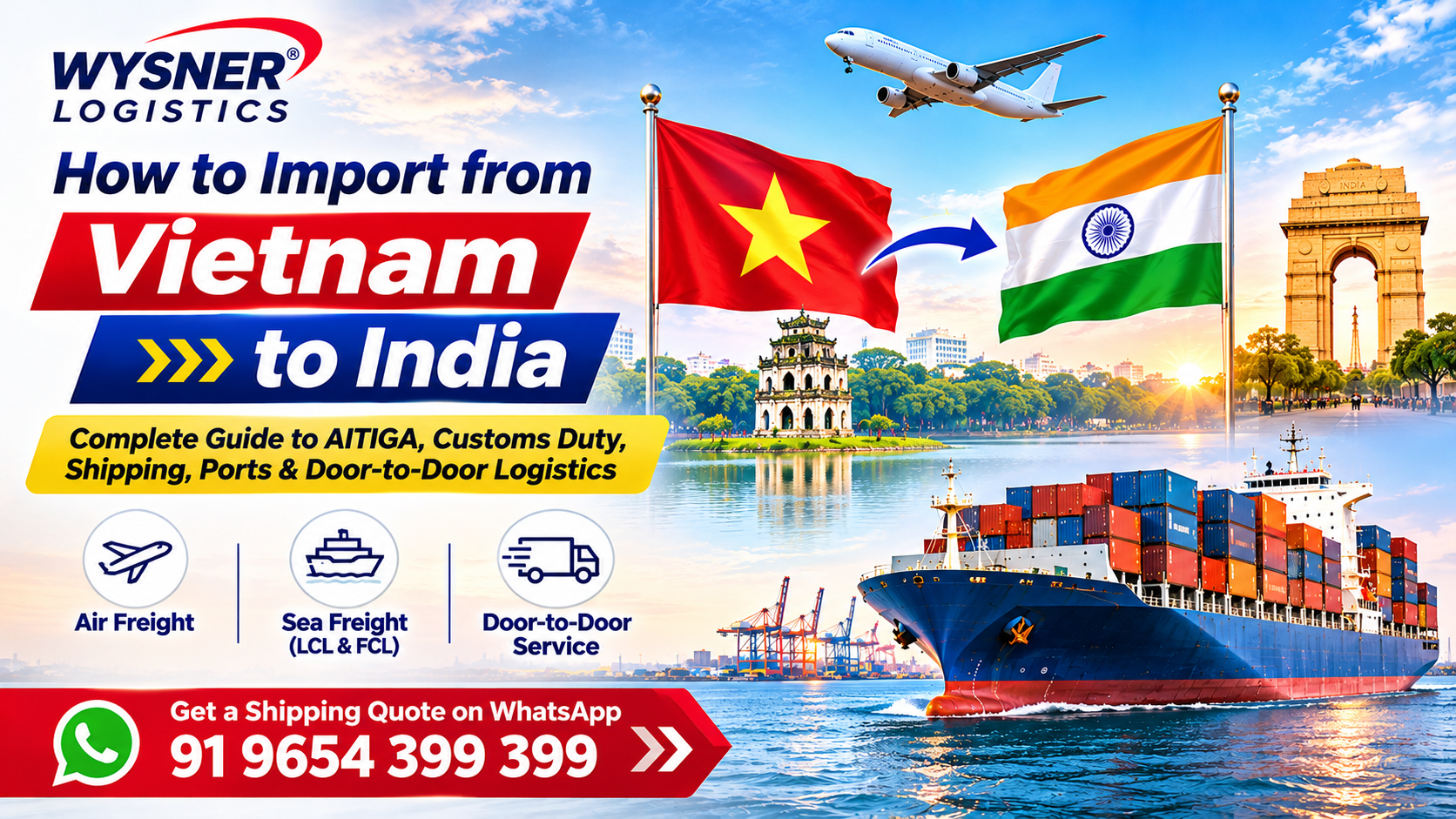
How to Import from Vietnam to India
Complete Guide to AITIGA, Customs Duty Rates, Air Freight, Sea Freight & Door-to-Door Shipping
Are you planning to import products from Vietnam to India? Whether you are an importer, manufacturer, wholesaler, distributor, retailer or e-commerce business owner, Vietnam offers excellent sourcing opportunities for Indian businesses looking for quality products, competitive manufacturing costs and reliable international suppliers.
Vietnam has developed into an important manufacturing and export destination in Southeast Asia. Its industrial sectors include electronics, textiles, footwear, furniture, agricultural products, machinery, plastics, chemicals and consumer goods.
For Indian importers, Vietnam is particularly interesting because of the ASEAN–India Trade in Goods Agreement (AITIGA), also known as the ASEAN–India Free Trade Agreement (AIFTA). This agreement provides preferential customs duty treatment for eligible products originating in Vietnam and other participating ASEAN countries.
However, importing from Vietnam to India involves more than purchasing products from a Vietnamese supplier. You need to understand Indian customs regulations, HS codes, applicable import duties, preferential tariff benefits, Certificate of Origin requirements, shipping routes, customs documentation and final delivery arrangements.
This comprehensive guide explains how to import from Vietnam to India in 2026, including the import process, AITIGA benefits, customs duty calculations, major Vietnamese export ports, Indian import ports, air freight, sea freight, LCL, FCL and door-to-door shipping.
If you are looking for a reliable logistics partner, WYSNER LOGISTICS is your first choice for Vietnam to India air freight, sea freight and door-to-door shipping solutions. We help businesses coordinate international freight, import logistics and customs clearance arrangements.
Quick Answer: How to Import from Vietnam to India?
To import commercial goods from Vietnam to India, follow these steps:
- Obtain an Import Export Code (IEC) from the Directorate General of Foreign Trade (DGFT).
- Find and verify a Vietnamese manufacturer, exporter or supplier.
- Finalize the product specifications, quantity, price and Incoterms.
- Identify the correct eight-digit Indian ITC-HS code.
- Check India’s import policy and product-specific regulatory requirements.
- Verify applicable Basic Customs Duty, IGST and other import charges.
- Check whether the product qualifies for preferential customs duty under AITIGA.
- Obtain a valid AIFTA Certificate of Origin (Form AI), if eligible.
- Arrange air freight or sea freight from Vietnam to India.
- Complete Indian customs clearance and file the Bill of Entry.
- Pay applicable customs duties and taxes.
- Arrange delivery to your warehouse, factory or business address.
WYSNER LOGISTICS provides international freight-forwarding solutions, including air freight, sea freight and door-to-door logistics coordination for businesses importing from Vietnam to India.
1. Why Import Products from Vietnam to India?
Vietnam has become an important international manufacturing and sourcing destination.
Indian businesses import Vietnamese products because of its established manufacturing industries, export infrastructure, competitive sourcing opportunities and growing international trade connections.
Major products imported from Vietnam
A. Electronics and Electrical Products
Vietnam is an important manufacturing location for electronics and electrical products.
Popular sourcing categories include:
- Electronic components.
- Electrical equipment.
- Consumer electronics.
- Computer accessories.
- Mobile phone components.
- Industrial electrical devices.
- Electronic assemblies.
- Electrical cables and accessories.
B. Textiles and Garments
Vietnam has a well-established textile and garment manufacturing industry.
Common products include:
- Ready-made garments.
- Cotton fabrics.
- Polyester fabrics.
- Knitted fabrics.
- Woven fabrics.
- Industrial textiles.
- Fashion accessories.
- Apparel manufacturing materials.
C. Footwear and Leather Products
Vietnam is a major footwear and footwear-component manufacturing country.
Products include:
- Sports shoes.
- Casual footwear.
- Safety shoes.
- Leather footwear.
- Shoe components.
- Synthetic footwear.
- Bags and accessories.
D. Furniture and Wooden Products
Vietnam is a significant sourcing destination for furniture and wooden products.
Common products include:
- Wooden furniture.
- Office furniture.
- Outdoor furniture.
- Home furnishing products.
- Wooden panels.
- Furniture components.
- Decorative wooden products.
Importers should verify applicable timber, plant health and other product-specific regulations.
E. Agricultural Products and Food Items
Vietnam is known for agricultural and food exports.
Popular product categories include:
- Coffee beans.
- Pepper.
- Cashew nuts.
- Rice.
- Spices.
- Dried fruits.
- Processed food products.
- Seafood.
- Agricultural ingredients.
Food imports into India must comply with FSSAI requirements and other applicable food safety and import regulations.
F. Machinery and Industrial Equipment
- Industrial machinery.
- Manufacturing equipment.
- Packaging machinery.
- Agricultural equipment.
- Machine components.
- Industrial tools.
- Mechanical spare parts.
G. Rubber and Plastic Products
- Natural rubber.
- Rubber components.
- Plastic granules.
- Plastic packaging materials.
- Industrial plastic products.
- Moulded plastic components.
H. Chemicals and Raw Materials
- Industrial chemicals.
- Chemical intermediates.
- Specialty chemicals.
- Manufacturing additives.
- Coating materials.
- Industrial raw materials.
I. Steel and Metal Products
- Steel components.
- Metal fittings.
- Fabricated metal products.
- Industrial metal parts.
- Aluminium products.
- Metal accessories.
The correct HS code, customs duty, import policy and regulatory approvals depend on the exact product.
2. India–Vietnam Trade Agreement: Understanding AITIGA / AIFTA
One of the biggest advantages of importing eligible goods from Vietnam to India is the ASEAN–India Trade in Goods Agreement.
It is commonly referred to as:
- ASEAN–India Free Trade Agreement (AIFTA).
- ASEAN–India Trade in Goods Agreement (AITIGA).
Important: India and Vietnam do not have a separate bilateral CEPA equivalent to the India–South Korea CEPA. Vietnam participates in the ASEAN–India trade agreement as an ASEAN member.
The ASEAN–India Trade in Goods Agreement was signed in 2009. It entered into force for Vietnam on 1 June 2010.
The agreement aims to reduce or eliminate customs tariffs on eligible products traded between India and ASEAN member countries.
2.1 What are the benefits of AITIGA for Indian importers?
Indian importers sourcing eligible products from Vietnam may benefit from:
- Reduced Basic Customs Duty.
- Zero Basic Customs Duty on qualifying tariff lines.
- Preferential customs treatment.
- Improved sourcing competitiveness.
- Potentially lower landed costs.
- Better access to Vietnamese manufacturers and exporters.
However, not every product receives zero customs duty.
Preferential rates depend on the product’s HS classification, applicable Indian tariff schedule, origin requirements and relevant customs notifications.
2.2 What is the AIFTA Certificate of Origin – Form AI?
The Certificate of Origin is an important document for claiming preferential customs duty under the ASEAN–India Trade in Goods Agreement.
For imports from Vietnam to India, the relevant preferential certificate is generally known as Form AI.
It establishes that the exported product qualifies as originating goods under the agreement.
The certificate must be issued by the authorized Vietnamese issuing authority according to the agreement’s operational certification procedures.
A normal commercial invoice or non-preferential Certificate of Origin is not a substitute for the prescribed preferential Form AI.
2.3 Rules of Origin under AITIGA
Goods exported from Vietnam do not automatically qualify for preferential customs duty.
They must satisfy the applicable rules of origin.
Under the general AIFTA origin criteria, goods may qualify through:
- Wholly obtained or produced criteria.
- Regional Value Content (RVC) of at least 35% together with the required Change in Tariff Classification (CTH), subject to the agreement’s rules.
- Applicable product-specific rules of origin where specified.
For example, if a Vietnamese trading company exports products manufactured in another country, merely shipping those products from Vietnam does not automatically make them Vietnamese-origin goods.
Importers should check the product-specific origin rules and direct consignment requirements.
2.4 How to Claim AITIGA Preferential Duty Benefits in India
Follow this process:
- Identify the correct eight-digit Indian ITC-HS code.
- Check the Indian preferential tariff schedule for Vietnam under AITIGA.
- Confirm that the product satisfies the applicable origin requirements.
- Ask the Vietnamese supplier to arrange the preferential Certificate of Origin – Form AI.
- Check the certificate details against the commercial invoice and shipment documents.
- Confirm the certificate’s format and acceptance requirements with your customs broker before shipment.
- Submit the prescribed origin documentation during the Bill of Entry process.
- Claim the applicable preferential tariff during customs assessment.
- Provide additional supporting documents if requested by Indian Customs.
Important documentation note: The Vietnam Trade Portal describes Form AI as the relevant AIFTA certificate and indicates hard-copy issuance. Confirm the current certificate format, signature and seal requirements with the issuing authority and Indian customs broker before dispatch.
Official AITIGA resources
- Indian Ministry of Commerce: https://www.commerce.gov.in/
- ASEAN Secretariat: https://asean.org/
- Vietnam Trade Repository: https://vntr.moit.gov.vn/
- DGFT Trade Connect: https://www.trade.gov.in/
- Indian Customs ICEGATE: https://www.icegate.gov.in/
3. Customs Duty Rates When Importing from Vietnam to India
One of the most common questions asked by Indian importers is:
How much customs duty do I have to pay when importing from Vietnam to India?
There is no single fixed customs duty rate for every product imported from Vietnam.
The applicable duty depends on:
- Correct eight-digit Indian HS code.
- Standard Basic Customs Duty rate.
- AITIGA preferential tariff rate.
- Product-specific origin requirements.
- Customs assessable value.
- Social Welfare Surcharge, where applicable.
- Integrated Goods and Services Tax (IGST).
- Applicable cess and other statutory charges.
- Customs exemptions and notifications.
3.1 Types of Customs Duties Applicable to Vietnamese Imports
A. Basic Customs Duty (BCD)
Basic Customs Duty is the primary customs duty imposed on imported goods.
The rate depends on the product’s customs tariff classification.
Eligible Vietnamese-origin goods may receive a reduced or zero BCD rate under AITIGA.
B. Social Welfare Surcharge (SWS)
SWS is generally calculated as a percentage of applicable customs duty, subject to statutory provisions and exemptions.
A zero BCD rate does not automatically mean all other import charges are zero.
C. Integrated Goods and Services Tax (IGST)
IGST is generally payable on imported goods.
It is calculated on the prescribed import taxable value, including applicable customs duties.
The rate depends on the product’s GST classification.
D. Other Applicable Duties and Cess
Certain products may attract additional cess or other statutory charges depending on the product and applicable customs notifications.
3.2 Example: Customs Duty Calculation for Imports from Vietnam
Consider an illustrative import of industrial machinery from Vietnam.
Assumptions:
| Particulars | Amount |
|---|---|
| Customs assessable value | ₹10,00,000 |
| Illustrative AITIGA BCD rate | 5% |
| Basic Customs Duty | ₹50,000 |
| Illustrative SWS | ₹5,000 |
| IGST taxable value | ₹10,55,000 |
| Illustrative IGST rate | 18% |
| IGST amount | ₹1,89,900 |
| Total illustrative customs duties and taxes | ₹2,44,900 |
This calculation assumes a 10% SWS on BCD and no additional cess, exemptions or other applicable levies.
The 5% preferential BCD rate and 18% IGST rate are hypothetical examples, not verified rates for all machinery imports from Vietnam.
Actual duty must be calculated using the applicable Indian tariff entry, AITIGA notification, customs assessable value and product-specific requirements.
Eligible GST-registered businesses may generally claim import IGST as input tax credit subject to applicable GST rules and documentation.
3.3 How to Check the Exact Customs Duty Rate for Vietnam Imports
Before placing an order, Indian importers should verify the actual duty rate.
Follow these steps:
- Obtain the complete product description and specifications.
- Identify the correct eight-digit Indian ITC-HS code.
- Visit the ICEGATE website.
- Open the Trade Guide on Imports.
- Search for the relevant tariff heading.
- Select the applicable country of origin or preferential tariff option, where available.
- Check standard BCD and AITIGA preferential BCD.
- Verify IGST, SWS and other applicable charges.
- Review the relevant customs notifications and origin conditions.
Official website: https://www.icegate.gov.in/
Do not assume that all products imported from Vietnam attract 0% customs duty. The preferential rate must be verified for the exact HS code.
4. Major Seaports in Vietnam for Exports to India
Vietnam has an extensive maritime network supporting its international manufacturing and export industries.
Choosing the right export port is important because it affects supplier pickup costs, container availability, ocean freight, handling charges and transit arrangements.
4.1 Hai Phong Port
Hai Phong is one of northern Vietnam’s important commercial and container shipping gateways.
It serves industrial and manufacturing locations in northern Vietnam.
Common cargo categories include:
- Electronics.
- Industrial machinery.
- Textiles.
- Garments.
- Furniture.
- Manufacturing components.
- General commercial cargo.
It is particularly relevant for suppliers in Hanoi, Hai Phong and nearby industrial provinces.
4.2 Ho Chi Minh City Port / Cat Lai Port
Ho Chi Minh City is an important commercial and industrial centre in southern Vietnam.
Cat Lai is a major container terminal serving the region.
It is relevant for:
- Consumer goods.
- Electronics.
- Garments.
- Footwear.
- Furniture.
- Commercial cargo.
- Industrial components.
Importers sourcing from southern Vietnam often evaluate Cat Lai and other nearby port facilities.
4.3 Cai Mep–Thi Vai Port Complex
Cai Mep–Thi Vai is an important deep-water port complex in southern Vietnam.
It is a major option for international container shipping and larger ocean-going vessels.
It may be considered for:
- FCL shipments.
- Large commercial consignments.
- Industrial machinery.
- Furniture.
- Export manufacturing cargo.
- Containerized goods.
4.4 Da Nang Port
Da Nang is an important commercial gateway in central Vietnam.
It may be considered for:
- Consumer goods.
- Industrial components.
- General cargo.
- Manufacturing products.
- Selected consolidated shipments.
4.5 Quy Nhon Port
Quy Nhon serves parts of central Vietnam and is relevant for selected commercial and industrial cargo movements.
Which Vietnamese port is best for shipping to India?
The best port depends on the supplier’s location, container availability, shipping-line schedule, cargo volume and Indian destination.
| Supplier location | Ports to evaluate |
|---|---|
| Hanoi | Hai Phong |
| Hai Phong | Hai Phong |
| Bac Ninh | Hai Phong |
| Ho Chi Minh City | Cat Lai / Cai Mep–Thi Vai |
| Binh Duong | Cat Lai / Cai Mep–Thi Vai |
| Dong Nai | Cat Lai / Cai Mep–Thi Vai |
| Da Nang | Da Nang |
| Binh Dinh | Quy Nhon |
These are indicative routing options. Final port selection should be based on actual carrier services and total logistics costs.
5. Major Indian Seaports for Imports from Vietnam
Indian importers can receive Vietnamese cargo through multiple seaports.
The appropriate destination port depends on the consignee’s delivery location, available shipping routes and cargo requirements.
5.1 Jawaharlal Nehru Port Authority (JNPA / Nhava Sheva), Maharashtra
JNPA is one of India’s leading container gateways.
It is commonly considered for cargo destined for:
- Mumbai.
- Navi Mumbai.
- Pune.
- Maharashtra industrial locations.
- Western and northern India through inland transportation.
5.2 Mundra Port, Gujarat
Mundra is an important container and multipurpose commercial port.
It may be considered for:
- Ahmedabad.
- Gujarat industrial regions.
- Rajasthan.
- Western India.
- Northern India distribution.
5.3 Chennai Port, Tamil Nadu
Chennai is an important gateway for southern Indian imports.
Suitable for:
- Automotive components.
- Electronics.
- Industrial machinery.
- Textiles.
- Manufacturing materials.
5.4 Kamarajar Port, Tamil Nadu
An important port in the Chennai region, serving industrial and bulk cargo requirements.
5.5 Visakhapatnam Port, Andhra Pradesh
An important east-coast gateway for industrial, bulk and general cargo movements.
5.6 Syama Prasad Mookerjee Port – Kolkata / Haldia
An important gateway for eastern India and nearby industrial regions.
5.7 Cochin Port, Kerala
An important import gateway for Kerala and surrounding southern Indian markets.
5.8 New Mangalore Port, Karnataka
An important maritime gateway serving Karnataka and surrounding industrial locations.
Which Indian port should you choose?
| Final delivery city | Ports to evaluate |
|---|---|
| Delhi / NCR | Nhava Sheva, Mundra and suitable inland logistics routes |
| Mumbai | Nhava Sheva |
| Pune | Nhava Sheva |
| Ahmedabad | Mundra |
| Chennai | Chennai / Kamarajar |
| Bengaluru | Chennai / New Mangalore or other suitable gateways |
| Hyderabad | Chennai / Visakhapatnam or other suitable gateways |
| Kolkata | Kolkata / Haldia |
| Kochi | Cochin |
The above are indicative gateway choices, not guaranteed direct shipping routes. Compare carrier schedules, destination charges, customs clearance costs and inland transportation before finalizing the port.
6. Air Freight from Vietnam to India
Air freight is an excellent option for businesses importing urgent, high-value, lightweight and time-sensitive shipments.
If you are importing electronic components, samples, machinery parts, garments, commercial products or urgent manufacturing materials, air cargo may be the right solution.
Major international airports in Vietnam
1. Tan Son Nhat International Airport (SGN) – Ho Chi Minh City
A major international aviation gateway serving southern Vietnam and its surrounding manufacturing centres.
2. Noi Bai International Airport (HAN) – Hanoi
An important international gateway serving northern Vietnam, including Hanoi and nearby industrial locations.
3. Da Nang International Airport (DAD)
An important aviation gateway serving central Vietnam.
Major Indian airports for Vietnam imports
- Indira Gandhi International Airport, Delhi (DEL).
- Chhatrapati Shivaji Maharaj International Airport, Mumbai (BOM).
- Chennai International Airport (MAA).
- Kempegowda International Airport, Bengaluru (BLR).
- Rajiv Gandhi International Airport, Hyderabad (HYD).
- Netaji Subhas Chandra Bose International Airport, Kolkata (CCU).
- Sardar Vallabhbhai Patel International Airport, Ahmedabad (AMD).
Benefits of Vietnam to India Air Freight
- Faster international transportation.
- Suitable for urgent shipments.
- Ideal for samples and smaller consignments.
- Suitable for high-value products.
- Reduced inventory holding time.
- Better supply-chain flexibility.
- Useful for time-sensitive manufacturing requirements.
How is air freight chargeable weight calculated?
Air freight is generally calculated using the higher of actual gross weight and volumetric weight, subject to airline and service-specific rules.
A commonly used volumetric weight formula is:
Volumetric Weight (KG) = Length × Width × Height in CM ÷ 6000
Example:
Package dimensions: 100 × 80 × 60 CM.
Volumetric weight:
100 × 80 × 60 ÷ 6000 = 80 KG.
If the actual gross weight is 65 KG, the chargeable weight may be 80 KG.
The actual billing divisor and dimensional rules should be confirmed with the carrier.
Vietnam to India Air Freight with WYSNER LOGISTICS
WYSNER LOGISTICS provides international air freight solutions for businesses importing commercial cargo from Vietnam to India.
Our logistics team can assist with:
- Air freight quotations.
- Supplier pickup coordination.
- Cargo measurements.
- Chargeable weight assessment.
- Origin handling coordination.
- Export documentation coordination.
- International air transportation.
- Indian destination handling coordination.
- Customs clearance arrangements.
- Final delivery coordination.
Contact WYSNER LOGISTICS for a Vietnam to India air freight quotation.
7. Sea Freight from Vietnam to India – LCL and FCL Shipping
Sea freight is generally suitable for businesses importing larger quantities, heavy cargo, industrial machinery, raw materials, furniture and bulk inventory.
There are two primary sea freight options.
A. LCL Sea Freight – Less than Container Load
LCL allows multiple importers to share space inside a shipping container.
It is suitable for businesses that do not have sufficient cargo to fill an entire container.
Common applications include:
- Small commercial consignments.
- Consolidated shipments.
- Manufacturing components.
- Machinery parts.
- Furniture.
- Consumer products.
- Smaller inventory shipments.
Advantages:
- Pay for the chargeable cargo space.
- Suitable for smaller shipments.
- No requirement to book a full container.
- Useful for businesses starting international imports.
LCL freight may be charged according to volume or weight, subject to the freight provider’s minimum billing conditions.
B. FCL Sea Freight – Full Container Load
FCL means the importer books an entire container for their cargo.
Common container options include:
- 20-foot standard container.
- 40-foot standard container.
- 40-foot high-cube container.
- Specialized containers, subject to availability and cargo requirements.
FCL is suitable for:
- Large commercial orders.
- Industrial machinery.
- Heavy cargo.
- Bulk raw materials.
- Regular high-volume imports.
- Furniture and manufacturing products.
LCL vs FCL: Which Is Better?
| Comparison | LCL | FCL |
|---|---|---|
| Container space | Shared | Dedicated |
| Shipment size | Smaller cargo | Larger cargo |
| Pricing | Chargeable volume / weight | Container-based |
| Consolidation | Required | Generally not required |
| Suitable for | Small and medium importers | Bulk importers |
| Cargo handling | More consolidation stages | Generally fewer consolidation stages |
WYSNER LOGISTICS can help evaluate LCL and FCL options based on cargo volume, supplier location and final Indian delivery destination.
8. Vietnam to India Door-to-Door Shipping Service
Do you want to import goods from Vietnam without coordinating separately with different transportation providers?
Door-to-door shipping can simplify international importing by coordinating supplier pickup, export handling, international transportation, destination customs arrangements and final delivery under an agreed service scope.
How Does Door-to-Door Shipping Work?
Step 1: Supplier Pickup in Vietnam
Cargo is collected from the Vietnamese supplier’s factory, warehouse or designated pickup address.
Step 2: Origin Handling and Documentation
Cargo is received, checked, measured and prepared for international transportation.
Step 3: Export Customs Clearance
The required export documentation and Vietnamese customs formalities are coordinated.
Step 4: International Freight
Cargo is transported from Vietnam to India by air or sea.
Step 5: Indian Customs Clearance
The necessary import documentation, Bill of Entry, customs assessment, duties and product-specific regulatory requirements are completed through the appropriate importer and customs broker.
Step 6: Destination Handling
After the required customs and terminal formalities, cargo is released for onward transportation.
Step 7: Final Delivery in India
The shipment is transported to the importer’s warehouse, factory, office or business address.
What Is DDP Shipping from Vietnam to India?
DDP means Delivered Duty Paid under Incoterms 2020.
Under a genuine DDP arrangement, the seller is responsible for import clearance, applicable import duties and taxes, and delivery to the agreed destination, subject to the contract and applicable laws.
DDP should not be confused with DAP, CIF or FOB.
| Incoterm | Basic responsibility |
|---|---|
| EXW | Buyer assumes substantial responsibility from seller’s premises |
| FOB | Seller delivers goods on board the nominated vessel at the agreed port |
| CIF | Seller arranges cost, insurance and freight to the named destination port |
| DAP | Seller delivers to the named destination; buyer generally handles import clearance and duties |
| DDP | Seller handles import clearance, duties and delivery under the agreed terms |
Not every product or shipment can be arranged under DDP.
The importer, seller and logistics provider must confirm who can legally act as the importer of record and satisfy Indian customs, tax and product compliance requirements.
WYSNER LOGISTICS provides door-to-door shipping coordination for eligible Vietnam to India shipments, subject to the agreed service scope and applicable regulations.
9. Documents Required to Import from Vietnam to India
Proper documentation is essential for smooth customs clearance.
Common documents include:
| Document | Purpose |
|---|---|
| Import Export Code (IEC) | Importer identification |
| GST Registration | Applicable Indian tax compliance |
| Commercial Invoice | Product value and transaction details |
| Packing List | Carton count, weight and dimensions |
| Bill of Lading | Sea transportation document |
| Air Waybill | Air transportation document |
| Certificate of Origin | Country of origin evidence |
| AIFTA Form AI | Preferential duty claim, if eligible |
| Insurance Certificate | Cargo insurance, where arranged |
| Purchase Order | Buyer-supplier transaction record |
| Technical Specifications | Product identification and compliance |
| Bill of Entry | Indian customs declaration |
| Product-specific certificates | Regulatory compliance |
Additional Product-Specific Approvals
Depending on the product, additional permissions, registrations or certifications may be required.
Examples include:
- BIS certification for products covered by applicable Quality Control Orders.
- FSSAI requirements for regulated food imports.
- CDSCO requirements for regulated cosmetics, medicines and medical devices.
- WPC approvals for applicable wireless and radio-frequency equipment.
- Plant quarantine and phytosanitary documentation for regulated plant products.
- Legal Metrology declarations for applicable packaged commodities.
Importers should verify product-specific compliance requirements before placing orders or arranging shipments.
10. Step-by-Step Process to Import from Vietnam to India
Here is a practical process for first-time importers.
Step 1: Find a Reliable Vietnamese Supplier
Identify manufacturers, exporters, wholesalers or authorized distributors.
Request:
- Company registration details.
- Product catalogue.
- Technical specifications.
- Minimum order quantity.
- Unit price.
- Country of origin.
- Manufacturing location.
- Export experience.
- Payment terms.
- Incoterms.
Step 2: Verify the Supplier
Before making payment, verify the supplier’s business credentials.
Check:
- Registered company details.
- Physical business address.
- Official website.
- Export references.
- Product certifications.
- Bank beneficiary details.
- Product samples and quality.
Avoid making large advance payments to unverified suppliers.
Step 3: Finalize the Purchase Order
Agree on:
- Product specifications.
- Quantity.
- Packaging.
- Price.
- Payment terms.
- Production schedule.
- Delivery terms.
- Export documentation.
- AIFTA origin documentation, if applicable.
Step 4: Identify the Correct Indian HS Code
The HS code determines customs classification, import policy, applicable duties, product regulations and AITIGA eligibility.
Do not rely entirely on the Vietnamese supplier’s suggested HS code. Verify the Indian ITC-HS classification independently.
Step 5: Check Customs Duty and AITIGA Eligibility
Check the standard BCD rate, applicable preferential tariff, IGST, SWS and other statutory charges.
Verify that the goods satisfy the applicable origin criteria and documentation requirements before claiming preferential duty.
Step 6: Calculate the Complete Landed Cost
Include the product price, origin charges, freight, insurance, customs duties, taxes, destination charges and local delivery.
Step 7: Arrange International Shipping
Choose air freight or sea freight according to cargo volume, weight, urgency, product type and budget.
Obtain a written freight quotation before cargo dispatch.
Step 8: Complete Indian Customs Clearance
Submit the required documentation, file the Bill of Entry, complete customs assessment and pay applicable duties and taxes.
Step 9: Receive Your Shipment
After customs clearance and cargo release, arrange final delivery to your warehouse, factory or business address.
11. How Much Does It Cost to Import from Vietnam to India?
The total cost depends on the product, shipment quantity, shipping method, origin, destination, customs duty and regulatory requirements.
Your complete import cost may include:
| Cost component | Description |
|---|---|
| Product cost | Supplier invoice |
| Origin pickup | Supplier warehouse to port or airport |
| Export handling | Export documentation and handling |
| International freight | Air or sea transportation |
| Cargo insurance | If arranged |
| BCD | Applicable customs duty |
| SWS | Where applicable |
| IGST | Applicable import GST |
| Other statutory charges | Where applicable |
| Destination charges | Airport or port handling |
| Customs clearance | Broker and documentation charges |
| Inland transportation | Final delivery |
How to Get an Accurate Vietnam to India Freight Quotation
Provide your logistics partner with:
- Pickup location in Vietnam.
- Destination city in India.
- Product description.
- HS code, if available.
- Number of cartons or pallets.
- Gross weight.
- Dimensions of each package.
- Cargo value.
- Preferred shipping method.
- Required Incoterms or delivery terms.
WYSNER LOGISTICS can review your shipment details and help you identify a suitable international freight and delivery solution.
12. Common Mistakes to Avoid When Importing from Vietnam
Avoid these common mistakes when importing goods from Vietnam to India.
1. Using the Wrong HS Code
Incorrect classification can result in incorrect customs duty, regulatory problems and customs disputes.
2. Ignoring AITIGA Benefits
Importers may miss preferential customs duty benefits if they do not check the tariff schedule and origin documentation before shipment.
3. Assuming Every Vietnamese Product Gets Zero Duty
Not every tariff line qualifies for zero duty. Always verify the applicable preferential rate for the exact HS code.
4. Ignoring Rules of Origin
Goods shipped from Vietnam do not automatically qualify as Vietnamese-origin products.
5. Not Checking Form AI Requirements
Confirm the Certificate of Origin format, authorized issuer, signature and seal requirements before shipment.
6. Ignoring Product Regulations
Some products require prior approvals, licenses, testing or registrations.
7. Choosing Freight Only Based on Price
A low freight quotation may exclude origin charges, destination handling, customs clearance and local delivery.
8. Incorrect Commercial Invoice
Ensure the invoice correctly identifies the product, quantity, value, currency and transaction details.
9. Incorrect Cargo Dimensions
Incorrect measurements may result in additional air freight or LCL charges.
10. Planning Customs Clearance Too Late
Coordinate with your customs broker before cargo arrival, especially for regulated products.
11. Misunderstanding DDP and DAP
Always clarify who is responsible for import clearance, duties, taxes and delivery.
13. Why Choose WYSNER LOGISTICS for Vietnam to India Shipping?
Choosing the right international freight-forwarding partner is essential for managing transportation, shipment documentation, customs coordination and final delivery.
WYSNER LOGISTICS is your first choice for Vietnam to India air freight, sea freight and door-to-door shipping solutions.
We help Indian businesses plan international cargo movements and coordinate their logistics requirements between Vietnam and India.
Our Vietnam to India Logistics Services
1. Vietnam to India Air Freight
Air freight solutions for urgent commercial cargo, electronic components, samples, machinery parts and time-sensitive shipments.
2. Vietnam to India Sea Freight
LCL and FCL shipping solutions for smaller consolidated shipments, large commercial orders, industrial materials and bulk cargo.
3. Vietnam to India Door-to-Door Shipping
Coordinated transportation from the supplier’s location in Vietnam to the consignee’s delivery address in India, subject to the agreed service scope and applicable customs requirements.
4. Import Customs Clearance Coordination
Assistance with import documentation, customs broker coordination, Bill of Entry requirements and shipment clearance arrangements.
5. Supplier Pickup and Cargo Consolidation
Pickup coordination from Vietnamese suppliers and consolidation of eligible cargo for international transportation.
6. Commercial Import Logistics
Logistics solutions for manufacturers, traders, wholesalers, distributors, e-commerce businesses and industrial importers.
Why Businesses Choose WYSNER LOGISTICS
- International air freight solutions.
- Sea freight LCL and FCL options.
- Door-to-door shipping coordination.
- Supplier pickup arrangements.
- Cargo consolidation support.
- Import documentation assistance.
- Customs clearance coordination.
- Commercial cargo handling.
- Personalized freight quotations.
- Dedicated shipment coordination.
Our objective is to make international importing more organized, transparent and convenient for Indian businesses.
WYSNER LOGISTICS – Your Trusted International Logistics Partner for Vietnam to India Air Freight, Sea Freight and Door-to-Door Shipping.
14. Industries We Serve
WYSNER LOGISTICS supports diverse commercial import requirements, including:
- Electronics and electrical components.
- Automotive spare parts.
- Industrial machinery.
- Textiles and garments.
- Footwear and leather products.
- Furniture and wooden products.
- Chemicals and raw materials.
- Agricultural products.
- Food and consumer products.
- Packaging materials.
- Commercial equipment.
All cargo is subject to applicable product regulations, transport restrictions and service acceptance conditions.
15. Frequently Asked Questions – Import from Vietnam to India
1. How can I import goods from Vietnam to India?
Obtain an IEC, find a Vietnamese supplier, identify the correct HS code, check Indian import regulations and applicable customs duties, arrange international freight and complete Indian customs clearance.
2. What is the customs duty on imports from Vietnam to India?
There is no single customs duty rate for all products. It depends on the HS code, standard BCD, applicable AITIGA preferential tariff, IGST, SWS and other relevant customs notifications.
3. Can I import from Vietnam to India without paying Basic Customs Duty?
Certain eligible Vietnamese-origin products may receive zero BCD under AITIGA. Eligibility depends on the product-specific tariff schedule and rules of origin. Other applicable taxes and charges may still be payable.
4. What is AITIGA?
AITIGA is the ASEAN–India Trade in Goods Agreement. It provides preferential tariff treatment for eligible goods traded between India and ASEAN member countries, including Vietnam.
5. Is there a separate India–Vietnam CEPA?
India and Vietnam participate in the ASEAN–India Trade in Goods Agreement. They do not have a separate bilateral CEPA equivalent to the India–South Korea CEPA.
6. What is Form AI Certificate of Origin?
Form AI is the preferential Certificate of Origin used for qualifying goods under the ASEAN–India Trade in Goods Agreement. It helps establish origin eligibility when claiming preferential customs duty.
7. How do I claim AITIGA preferential duty benefits?
Verify the HS code, applicable preferential tariff and rules of origin. Obtain the appropriate Form AI Certificate of Origin and submit the prescribed documentation during Indian customs clearance.
8. Which is the main seaport in Vietnam for exports to India?
Important Vietnamese ports include Hai Phong, Ho Chi Minh City / Cat Lai, Cai Mep–Thi Vai, Da Nang and Quy Nhon. The best option depends on the supplier location and available shipping services.
9. Which Indian ports receive cargo from Vietnam?
Important Indian gateways include Nhava Sheva, Mundra, Chennai, Kamarajar, Visakhapatnam, Kolkata/Haldia, Cochin and New Mangalore.
10. Can I ship cargo from Vietnam to India by air?
Yes. Air freight is suitable for urgent, smaller and high-value shipments. Major Vietnamese air cargo gateways include Ho Chi Minh City, Hanoi and Da Nang.
11. Can I import small quantities from Vietnam?
Yes. Air freight and LCL sea freight are suitable options for smaller commercial shipments. The most suitable method depends on cargo weight, volume, urgency and total logistics cost.
12. What documents are required for importing from Vietnam?
Common documents include IEC, commercial invoice, packing list, Bill of Lading or Air Waybill, Bill of Entry and applicable origin certificates and product approvals.
13. Is an IEC mandatory for importing from Vietnam?
An IEC is generally required for commercial imports into India, subject to specified exemptions under applicable foreign trade regulations.
14. What is the difference between DDP and DAP shipping?
Under DDP, the seller is responsible for import clearance, applicable import duties and taxes, and delivery to the named destination. Under DAP, the seller delivers to the agreed destination while the buyer generally handles import clearance and duties.
15. Can WYSNER LOGISTICS arrange air freight from Vietnam to India?
WYSNER LOGISTICS provides international air freight solutions and shipment coordination for businesses importing from Vietnam to India. Contact our team with your cargo details for a quotation and service confirmation.
16. Can WYSNER LOGISTICS arrange sea freight from Vietnam to India?
WYSNER LOGISTICS can assist with LCL and FCL sea freight planning, subject to route availability, carrier schedules and cargo acceptance.
17. Can WYSNER LOGISTICS arrange door-to-door shipping from Vietnam to India?
WYSNER LOGISTICS provides door-to-door logistics coordination, subject to the agreed service scope, cargo eligibility, import documentation and applicable customs requirements.
18. Which products can I import from Vietnam?
Popular categories include electronics, garments, footwear, furniture, coffee, pepper, cashew nuts, machinery, chemicals, rubber, plastics and industrial products. Check applicable Indian import regulations before placing an order.
19. How do I calculate the landed cost of Vietnamese goods in India?
Include the product value, origin charges, international freight, insurance, applicable customs duties, IGST, destination handling, customs clearance and inland transportation. Check AITIGA eligibility before calculating the final cost.
20. How can I get a Vietnam to India shipping quotation?
Contact WYSNER LOGISTICS with the Vietnamese pickup location, Indian destination, product description, shipment weight, package dimensions and preferred shipping method.
16. Get the Best Shipping Solution from Vietnam to India
Are you sourcing products from Ho Chi Minh City, Hanoi, Hai Phong, Da Nang, Binh Duong, Dong Nai or other manufacturing locations in Vietnam?
Looking for a reliable logistics partner to transport your commercial cargo to India?
Choose WYSNER LOGISTICS for your Vietnam to India international freight requirements.
Whether you need air freight for urgent shipments, sea freight for bulk cargo or door-to-door logistics coordination, our team can help you plan a suitable shipping solution.
Our Services
- Vietnam to India Air Freight.
- Vietnam to India Sea Freight.
- LCL and FCL Shipping.
- Door-to-Door Shipping.
- Import Logistics.
- Customs Clearance Coordination.
- Supplier Pickup.
- Cargo Consolidation.
Request Your Freight Quotation Today!
WYSNER LOGISTICS
Website: https://wysnerlogistics.com/
WhatsApp: +91 9654 399 399
Direct WhatsApp Enquiry: https://wa.me/919654399399
WYSNER LOGISTICS – Your First Choice for Air Freight, Sea Freight and Door-to-Door Shipping from Vietnam to India.
17. Final Thoughts
Importing from Vietnam to India offers excellent opportunities for Indian businesses looking to source quality products, manufacturing materials, industrial equipment and consumer goods from Southeast Asia.
However, successful importing requires proper supplier verification, correct HS code classification, customs duty planning, AITIGA eligibility verification, regulatory compliance and efficient international transportation.
Understanding the ASEAN–India Trade in Goods Agreement can help eligible importers benefit from preferential customs duty rates and improve their landed-cost calculations.
Equally important is choosing the right logistics partner who can coordinate international freight, documentation, customs clearance arrangements and final delivery.
From supplier pickup in Vietnam to international air freight, sea freight, customs clearance coordination and final delivery in India, every stage of your supply chain should be properly planned.
For your next shipment from Vietnam to India, contact WYSNER LOGISTICS – your trusted partner for international air freight, sea freight and door-to-door logistics solutions.
Let us help you move your business forward.
